The following blog is an insight into an English naval blockade of Waterford and New Ross following an Irish uprising in 1641 which started the Confederate Wars 1641-1653. It is drawn from a first person account of Captain Thomas Powell of the armed merchantship Fellowship. When he sailed from Bristol on the 22nd Feb 1642, the 56 year old was not an experienced naval commander and it may have been his first voyage as such, having been hurriedly drafted into the navy after the war in Ireland had broken out.
According to the British National Archive, the Fellowship had in 1640 sailed for “New England and on to Newfoundland, and thence to Spain to bring back wines to Bristol …250 passengers on board…The previous year it had taken passengers and provisions to New England and Newfoundland, then brought fish to Spain and from there wines to Bristol.” Due to a lack of vessels, the ship was altered to supplement the naval presence around Ireland. The log and preamble state that he was involved as early as 1635 in trans-Atlantic trade. The ship and her master most likely originated in Bristol, but was very closely identified with Kinsale, Cork.
As regards the Fellowship vessel, David Edwards (linked below) states that it would be very difficult to be certain about the ship’s identity. Several vessels could have shared the same name in the same port of the era. A likely candidate “…would seem to be the 160-ton Fellowship of Bristol which was taken as a prize by a Parliament man-of-war sometime before May 1652, and was last heard of sailing towards Cadiz in August 1654.” David’s theory is based on the size of the vessel and the actions described in the ship’s log. See link at the end for further details.
While the Fellowship and other vessels worked to enforce a naval blockade of Ireland from Wexford around the southern coast and up to Galway, Powell kept a detailed log of progress or lack of it, and this edited account gives a sense of the activities in Waterford Harbour in March/April 1642.
Waterford city, New Ross, Passage and Ballyhack were in the hands of the Confederates. Only Duncannon was holding. His role was multifaceted – supporting Duncannon from the sea, enforcing a blockade of ships in or out of Waterford and New Ross, supporting the efforts of the army ashore and intercepting ships off the coast that were potential allies to the Irish or indeed Irish vessels operating as privateers on behalf of the Confederacy. My own thoughts or observations are included, largely [in brackets]. I have tried to italicise all direct pieces from the log for transparency and have left his spelling as I found it. You can read it yourself in full at a link provided at the end.
On the 3rd of March 1642 the Fellowship weighed anchor at about 8 am and set sail from Kinsale, Co Cork for Duncannon, Co Wexford in the company of the John. There was a steady gale from the west and fair weather.
4th March, all day the wind blew, and at 19:00 they anchored in about 4 fathoms on fine hard sand at Creaden Head in Waterford harbour. They were approximately 2 miles off, and Hook Tower was about 5 miles away. The winds continued through the night but at about 03:00 they sent a skiff ashore to ‘understand news’. The skiff returned about 10:00 with bad news for Powell and his crew: ‘Waterford was revolted and that the rebbells were very insolent on those parts’
The fifth day, in the afternoon, they weighed anchor and with the flood tide went up and anchored in 7 fathoms of water off Duncannon. The Lamb of Bristol was there as was the James of Youghal, The James had on board a prize of herring which had been taken by the fort. [Highlighting the importance of herring even then] They planned to ‘goe against Passage’ at 02:00, but due to adverse weather they dropped anchor again.
In the afternoon of the sixth they weathered a stiff gale from the west which continued into the night from the NW. At about 04:00 [of the following day I presume] they weighed anchor and went up to Passage where they anchored off Ballyhack in 6 fathoms of water and ‘battered against Ballihacke fort but with little harm’

Passage fort or blockhouse 1784 via Barony of Gaultier Historical Society http://gaultierhistoricalsociety.blogspot.com/2014/
That afternoon he landed some soldiers into Ballyhack who attacked the castle from the ground but were repelled; as they retreated, they burnt a great deal of the village. When his soldiers rejoined the vessel, two had been shot but, he claims, were not mortally injured. During the night the wind freshened again first SE then WNW and despite laying out their best anchor they were damaged, and the head of the rudder cracked. [No great detail was given on this but it may have been that they dragged anchor and collided with another vessel]
On the afternoon of February 8 they weighed anchor at 14:00 and against the tide arrived at Duncannon and dropped anchor at 17:00, a SSW stiff gale was blowing and a ‘greate sea’ was running. The weather continued very windy and they remained at an anchor as snow showers started to fall over the coming days.

Ballyhack Castle, Co Wexford. Author
On the 11th day [which I think was actually the 12th Feb] the James of Youghal set sail with the herring cargo for Bristol. At about noon a bark of ‘Irisry’ [which I assume means an Irish vessel] came down from Waterford with ‘many of the poore English (that had been stript by the rebells) to land them in England’
The 12th day at 23:00 a skiff brought men and musketeers up close to Passage to await some ‘Barckes coming downe from Waterford laden with foods of the Irishry’ [He does not record an outcome to this.] The weather continued bad on the 13th and on the 14th the James went up to Passage to take in passengers and returned back on the 15th in a stiff SW wind. [It seems he was either wrong about her earlier sailing for Bristol or she received other orders, but it’s not clear] In the afternoon of the 16th with westerly winds, the John set sail for Kinsale, also the James of Youghal and the ‘Irishe barcke with their passengers. The Swanne of his majesties coming from Milford, having taken a Ffrenchman that was laden with wine and corne, being bound for Rosse’
On the 17th day winds were blowing easterly; Powell mentions that ‘both our boates every night keeping watch expecting those Barckes what was to come downe from Waterford’ [Powell wanted to ensure that Waterford or New Ross could not export any goods which would have yielded finance to support the Confederacy]. The weather continued similar on the 18th.
On the 19th March, the vessel weighed anchor and set sail with southerly winds blowing in fair and clear weather. It seems their mission was to patrol off the harbour and to intercept any ships entering or leaving. Several times he mentions Creaden and the Tower – Hook Light.
At 10:00 on the 20th, they spotted sails off the coast which they intercepted and found to be a ‘Barcke of the fort’ with troops bound for Duncannon, and it seems that they were requested to assist in landing the troops with their own boats. [He does not describe how or where this was done but it highlights the reality of the English campaigns in Ireland and the vital role that shipping played in resourcing forts like Duncannon, in terms of food, supplies, arms and the never-ending need for troops due to illness, injury and death.] His next entry in that they put in and anchored in 5 ½ fathoms with the tower to the SE.

The location of the Fellowship and her area of action – Looking down from Ballyhack Hill with Duncannon on the left jutting out into the harbour. The Wexford shoreline continues on the left to the tip of Hook Head. Creaden can be seen on the right.
On the 22nd they again spotted a sail to the eastwards and boarding her they ‘found this to bee a ffrenchman of Croysicke [Corsica?] laden with wheat and rye bound for Waxford. Also wee found some Irish aboard of hir, but they had landed some others with their owne boat before wee could fetch them upp. Wee putt men aboard of hir to bring hir to Youghal or Kinsale.’ They also spotted a small ‘Barcke of Myniard with coals for the ffort.’ [Perhaps Minehead? located in Somerset on the Bristol Channel and a thriving port of that era]
It was the 24th when they arrived back at Duncannon, and again the weather was poor. On the 25th they delivered ashore 80 bushells of rye and 40 of wheat to Lord Laurence Esmond at the fort. The weather continued broken and the vessel stayed at anchor, assisting the fort by fitting carriages for unmounted cannon to defend the fort. These included one cannon of brass, two whole culverins and one demi culverin. The John returned from Kinsale during this time too.
On the 29th March 1642 the HMS Swanne [HMS Swann 1641] came down from Waterford and anchored off Duncannon. Aboard was the Countess of Ormond with her followers, who were sailing to Dublin to rejoin her husband. This was later joined by another ‘Barcke’ which was to sail in the company of the Swanne. The weather remained unsettled, however, and on the 30th he recorded ‘an extraordinary gale…with very hazie and thicke weather’
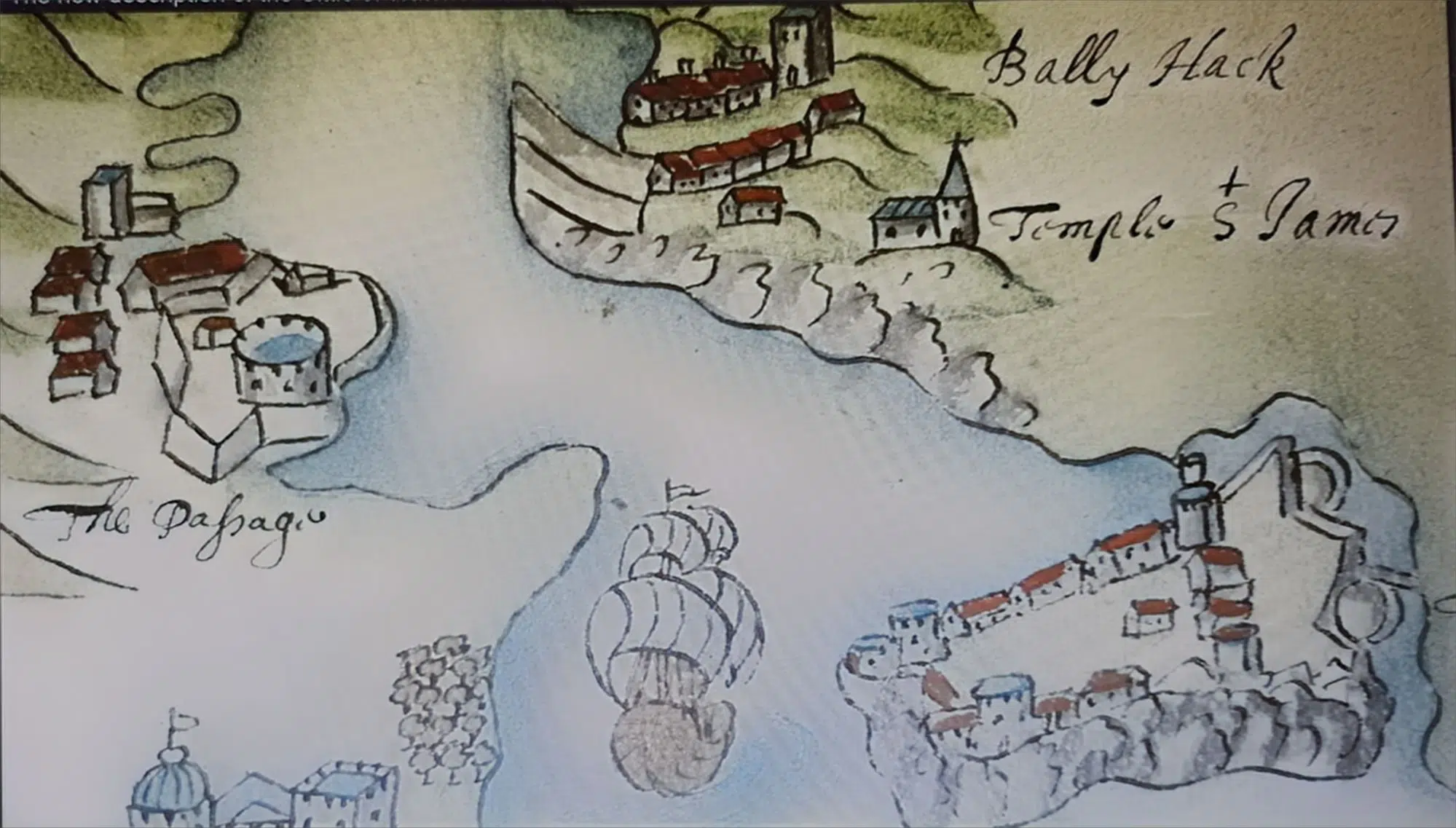
Detail of Ballyhack, Passage and Duncannon defences from the Jobson chart of 1591. See below for further detail.
The Countess and her two vessels departed on the 31st but the Fellowship stayed on her station. They spotted two boats proceeding up the southern shore towards Passage and their own boat followed them and ‘chaste them ashore’
April 1st was a blustery day with NW winds. Having spotted a ship at Creaden, they sent over their skiff to identify her. Unnamed in the log she is described as a Londoner from Calais and Lisbon with wines and sugar bound for ‘any port in Ireland that stood for his Majastie’ Another vessel passed up for Passage, but no details were recorded. Next day the ‘Londyners boate comminge upp was stayed by the governor of the ffort’. The following morning she ‘came upp and anchored in the road’ – I’m guessing this is a reference to off Passage, which was sometimes recorded as the Passage Roads, but Powell later mentions the Duncannon Roads]
On the 3rd the ‘Myniardsman sett sail for Bristoll’ while on the 4th the Fellowship landed 40 barrels of rye ashore to Captains Rustines and Weldings companies. This seems to be ashore to Duncannon fort. The wording here is very confusing and contradictory. He mentions 6 barrels for the ‘poore ashore’ and 13 barrels of wheat taken aboard.

Artist’s impression of the Fellowship off Ballyhack Castle via Tim Spillane
April 5th a small bark from Dublin came into harbour en route to Kinsale and reported that the Countess had arrived safely in Dublin and also that there had been a great overthrow of rebels in those parts [Again not sure but possible Kinsale area?] It later departed for Kinsale.
On the 6th day the prize [Again not clear but perhaps the previously mentioned French ship] set sail for Kinsale ‘Also a skiff was wayd [weighed anchor?] and stood out’ It seems the Fellowship dropped anchor at Creaden that evening and the following day came up and ‘stood upp againe into Duncannon road. In weighinge our anchor hurt form of our men at Captaine [capstan?]’ That same morning the prize returned with another bark due to foul weather off the coast.
The weather remained poor until the 12th when both the prize and the other bark set sail for Kinsale. The following day the Londoner set sail for Kinsale. On the 13th, unluckily for some, ten of Powell’s men went ashore to support soldiers, and four of them were taken by rebels and also some soldiers.

Jobson 1591 Chart of Waterford Harbour. A chart of Waterford Harbour by Francis Jobson 1591, showing the defences.” Trinity College Library. You can view the high definition here.
On the 14th they gave chase to a ship inbound but spotting three other sail broke off and went after those, which turned out to be English. With the wind being easterly, she joined them and sailed for Kinsale, losing their skiff in the process, which was being towed astern. They arrived at Kinsale on the 15th day where two of the ships were cleared to enter and the third, the herring prize, was sent to Youghal.
From there they departed for Limerick and with that I will leave the story. Powell was a loyal supporter of King Charles I in this log, but he would eventually cross to the Parliamentarian side. However, you can read the document for yourself from the following link
I will do a talk on the “Battles of Ballyhack” based on this dramatic era for Water Heritage Day at Ballyhack Castle on Sunday 23rd August at 2.30pm. Places are free but space is limited, so to book please ring us on 0469 422 544. We are open Sat to Wed 10am to 5pm. For further details on the week and some local events see here.
Ballyhack Castle (and Passage Fort) would hold out under the Confederates until the coming of Cromwell in 1649. Duncannon Fort was a complicated location due to the switching of allegiances between King Charles and the Parliamentarians, but it was eventually taken by the Confederates in 1645 and lost to Cromwells son in law Henry Ireton, in 1650. Another amazing success of the Confederates during this time was the loss of the Parliamentarian flagship Great Lewis at Duncannon previously posted on the page.
For more details on the era and the Royal Navy actions see this article from Dr Elaine Murphy in History Ireland. She also did this terrific podcast about Cromwells navy, which I would highly recommend.
This blog post is based on: The Ship’s Journal of Captain Thomas Powell, 1642 by David Edwards, Thomas Powell Analecta Hibernica, No. 37 (1998), pp. 251, 253-284 (33 pages)
Tides & Tales
We are a community-based initiative kept afloat by the generosity of people like you. Thank you for reading and hopefully you will visit again. It’s an ongoing voyage of discovery.
If Tides and Tales has informed, inspired, or simply entertained you, there are several meaningful ways you could support our work.
- Share this story with a friend, family member, or colleague.
- Leave a comment with feedback.
- Subscribe below to stay connected with our latest content.
- Follow our Facebook for local photos, events and general happenings.
- Other ways to assist financially if you can, include;
Donate—even a small contribution helps us keep the stories flowing.
Visit our shop and consider a purchase; all proceeds directly support the project.
A very interesting era and article Andrew. (The spellings of that era made me smile.) Good luck with your Heritage Week talks.