
A Guest blog by David Carroll.
In the Spring of 1941, Hitler ordered an intensification of air attacks on shipping in the coastal waters around the UK. As a result, the Irish Sea, St. Georges Channel, the Bristol Channel and the seas off the south coast of Ireland became very dangerous waters for all shipping – whether allied or neutral. While British registered ships were armed and could defend themselves, Irish registered ships had only their neutrality markings to protect them. These markings were often ignored by German aircraft. In the week of 12th–19th May 1941, four Irish ships were attacked from the air while on voyages between Irish and Welsh ports – the MV Menapia, the SS Assaroe, the SS Glenageary and the SS City of Waterford. None of these ships was sunk, though crew members on the Menapia and the City of Waterford were wounded by machine gun fire from the attacking aircraft.
Some of these attacks occurred very close to this country, and Irish Army personnel manning the Look Out Posts (LOPs) along the Waterford and Wexford coasts could see and record these attacks as they happened. They were eyewitnesses to the war, and the logbooks that they kept are a record of those attacks and how close the war came to Waterford. Another attack on an Irish vessel came at the end of May, and this was on the SS Kyleclare.
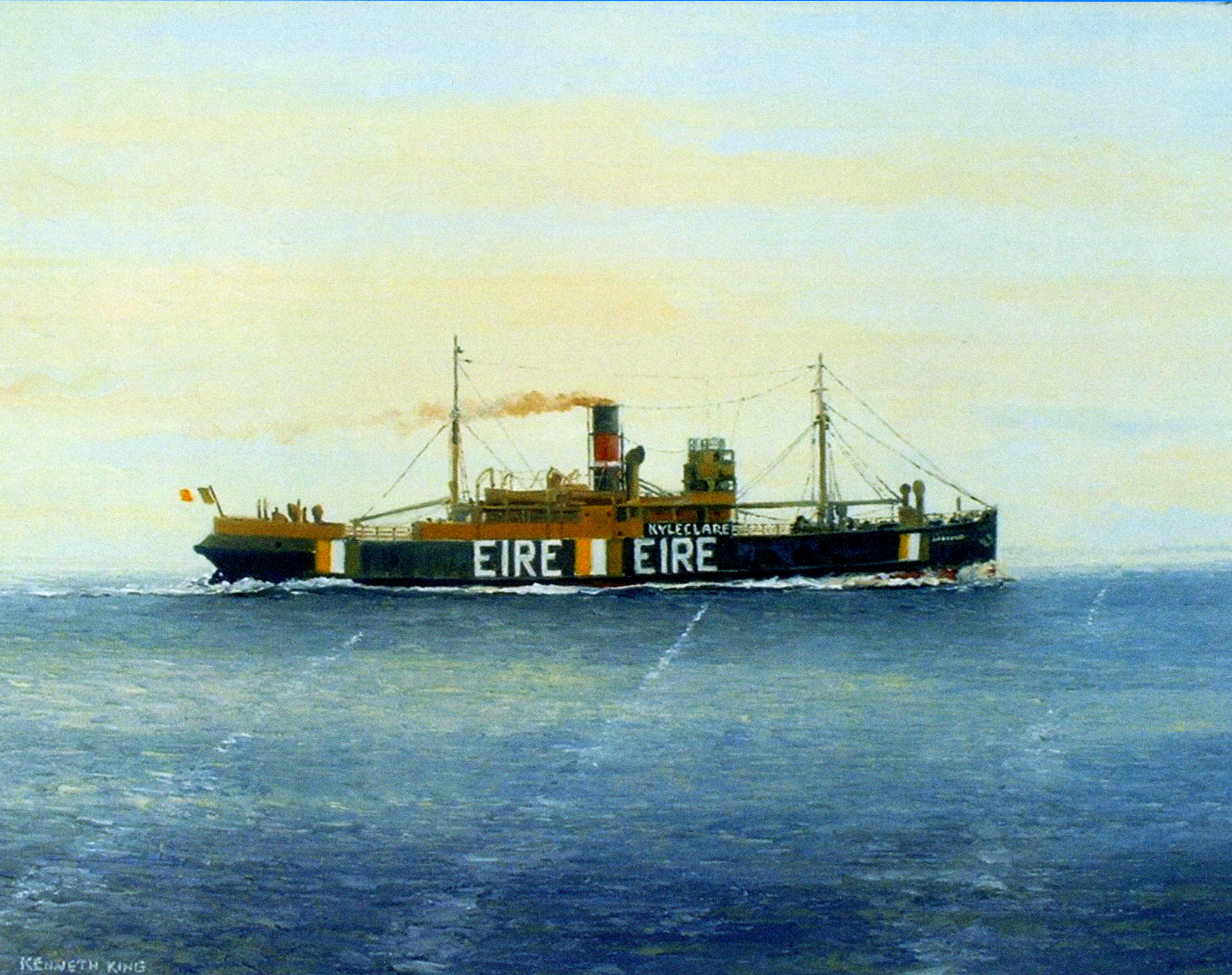
SS Kyleclare painted by Kenneth King. Courtesy of the National Maritime Museum of Ireland.
On May 29th, 1941, under the command of Captain Timothy Hanrahan, SS Kyleclare, belonging to the Limerick Steamship Company, departed from Fenit, Co Kerry, bound for Liverpool, with a general cargo. The following afternoon, the Look Out Post at Dunabrattin Head, LOP 18, sighted the Kyleclare at 15.10 hrs.
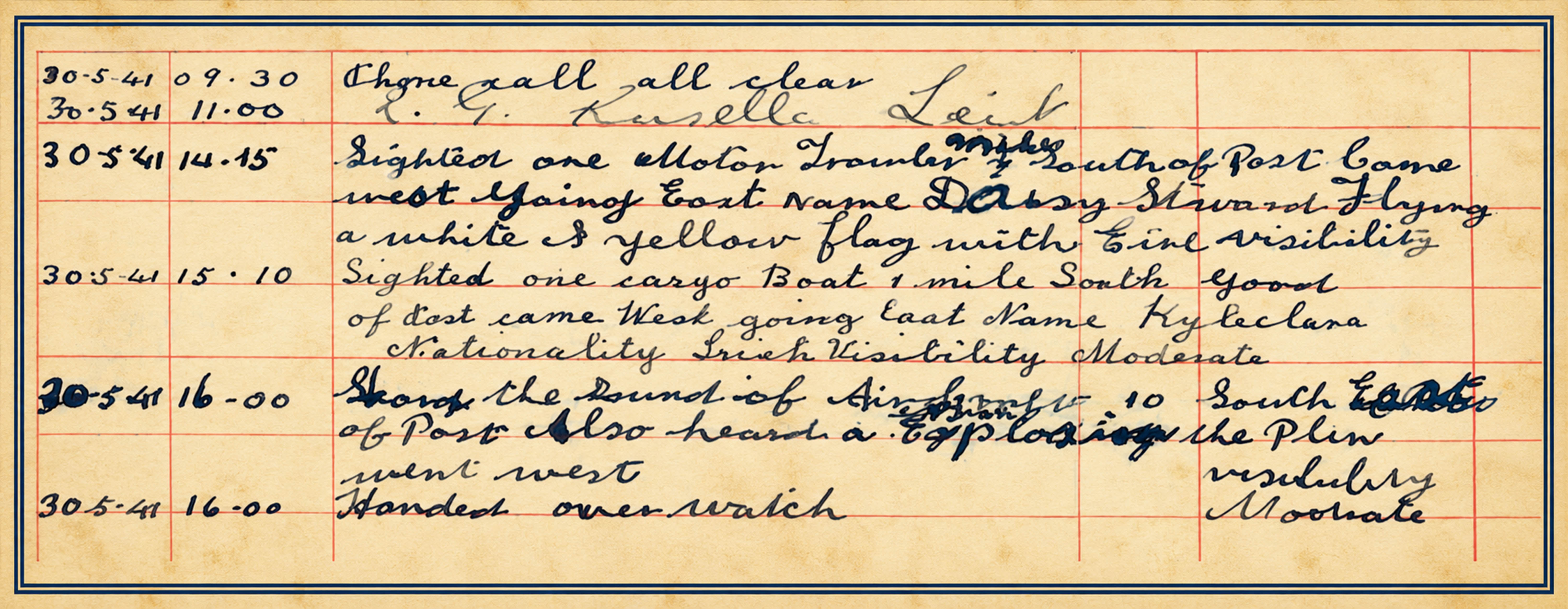
Extracts from the log book of Dunabrattin Head, LOP18 for May 30th, 1941.
The entry for 15.10 hrs. reads: “Sighted one cargo boat 1 mile South of Post came West going East Name Kyleclare Nationality Irish Visibility Moderate”. At 16.00hrs, the following entry was recorded: “Heard the sound of Aircraft 10 south-east of Post. Also heard an explosion the plane went west”.
The first log book of each of the 83 LOPs may be read online.
Later, Brownstown Head, LOP 17, reported sighting the vessel at 15.48 hrs. Corporal Richard Hanrahan, at LOP 17, reported that shortly after that, an aircraft was spotted, about one mile SE of Brownstown Head, which dropped six bombs and then flew to the E and then machine gunned the decks and then flew to the W. The report added that a bomb did not strike the vessel.[1]
A later report, stated: “Vessel is putting into Passage East and appears to be in a sinking condition.” A subsequent report, timed at 19.15 hrs., also archived at Military Archives, Cathal Brugha Barracks, originating from the Censor’s Office, reads as follows: “ Message from Lloyds, Waterford to Lloyds, London – Steamer Kyleclare from Limerick to Liverpool with general cargo reported making for Waterford, leaking badly as a result of enemy action. Pumps reported able to keep vessel going.”
A further report on the Kyleclare attack, from Command Intelligence Officer, Curragh, maintained in Military Archives, reads as follows:
“Kyleclare put into Waterford Harbour at 19.30hrs. The Garda were unable to obtain a statement from the Master of the vessel but hope to obtain one tomorrow morning. The following particulars regarding the attack were however received from members of the crew: The vessel carried a crew of 14, none of whom were injured during the attack. One of the bombs was stated to have struck the wheelhouse and glanced off into the water, where it exploded and loosened the ships plates both above and below the water line and the vessel is leaking badly as a result. Otherwise the damage to the vessel appears to be slight. The exact extent of the damage is however not yet available. The vessel was flying the Irish flag at the time of the attack and her colours were painted on prominent parts of the ship”.
A note in a side column states that Mr Walshe, from the Department of External Affairs, had been notified of the attack at 22.15 hrs. After the local fire brigade assisted with pumping and repairs had been effected, the Kyleclare resumed passage to Liverpool. [2] Dr Michael Kennedy, in his seminal book ‘Guarding Neutral Ireland- The Coast Watching Service and Military Intelligence, 1939-1945,’ states that aircraft that attacked the Kyleclare was a German Junkers Ju-88. [3]
The attack on the Kyleclare by the Luftwaffe was not the only one carried out in Ireland on this date, May 30th,1941. Later that night, four high explosive bombs were dropped by German aircraft on the North Strand district of Dublin City, killing twenty-eight persons, injuring over ninety, and destroying three hundred houses.
Before 1941 had ended, SS Kyleclare had been attacked again off the coast of County Waterford. This time, the ship was on a voyage from Liverpool to Limerick with general cargo. On December 7th, 1941, at 18.00hrs, when the ship was 3 miles from Mine Head and 3 ¼ miles from Helvick Head, a German plane, from the NE, in moderate visibility, dropped a bomb and an aerial torpedo, which missed the vessel and did not explode. No damage was caused. Four other German planes, seen in the vicinity, flew off in an unknown direction.[4]
News of the attack did not become known until two days later, when the vessel reached Fenit, at which port, the matter was reported to the Authorities.
The 211ft., 700-ton SS Kyleclare (Official Number 152256) had been built in 1932 at the Caledon Shipbuilding & Engineering Co. Ltd. in Dundee for the Limerick Steamship Company. She was the fourth vessel built for the Limerick Company’s fleet in the same yard. The other ships had been two sister-ships, SS Clonlara, (1926), and SS Lanahrone (1928), and also the smaller SS Moyolla (1927). The Moyolla and Kyleclare were built with shallow drafts to allow them to enter Ballina, Co. Mayo.[5]

A painting of the funnel and house flag of the Limerick Steamship Company, courtesy of Brian Cleare. The late history of the Waterford Steamship Company and growth of the Limerick Steamship Company are closely connected, through ownership. When the Limerick Company was formally established in 1893, it adopted the colours of the Waterford Company. The black funnel with a broad red band, was altered slightly by adding a thin white band beneath the red one. The Waterford house flag was the Cross of St George, on a white background with in each quarter, the letters W-S-S-Co. By a simple expedient of substituting an ‘L’ for a ‘W’, the Limerick Company had its new colours.[6]
Just over two months later, on July 30th, 1940, the SS Kyleclare picked up off Co Mayo, 52 survivors, in a lifeboat from the British SS Clan Menzies. The Clan Menzies had been sunk about 150 miles W of Loop Head in Co Clare by U-99 on July 29th.
The Kyleclare was again involved in a mission of mercy during 1941, when under the command of Captain Keogh, she was in Liverpool Bay on April 10th, 1941, just six weeks before being attacked off the Waterford coast. The Kyleclare spotted distress signals from a ship on the horizon and altered course towards the casualty. This was a Dutch coaster Virgo, disabled and leaking following a mine explosion and the Kyleclare managed to tow the disabled vessel back to Liverpool.[8]
A very distressing incident involving the Kyleclare took place in June 1942. On a voyage from Barry in Wales to Lisbon, under the command of Captain Dawson, when about 83 miles S of the Fastnet, the lookout man on the Kyleclare spotted a drifting raft to starboard, and a person lying on it could be seen, when the vessel got closer. There was no response when the whistle of the ship was blown. The Chief Officer was ordered to take a boat and investigate. Sadly, the man on the raft was dead. His only means of identification was a Royal Navy disc and it was discovered that his name was distinctly Irish- F O’Rourke. Prayers were recited and the body was allowed to sink in the water.
Subsequently, records show that he was Able Seaman Francis O’Rourke and he had died on June 18th, 1942, when the destroyer HMS Wild Swan was bombed and sunk by German aircraft in the Western Approaches.[9]
On September 15th, 1942, the Kyleclare, under the command of Captain Dawson, was en route from Lisbon to Dublin, (via Milford Haven as required by the British Navicert System), when it was stopped by a British Destroyer and a boarding party of ten came aboard and ordered the Kyleclare to proceed Liverpool. For the next two days, the boarding party searched the vessel from stem to stern, without saying what they were looking for. The Master felt that this episode was somehow connected to a warning received from the British Consul in Lisbon, who complained that members of the crew were frequenting bars which were out of bounds to Allied seamen.[10]

Kyleclare at Liverpool 1942. Military and naval personnel in close attendance. Photo courtesy of Terry Conlan.
Six weeks later, on November 30th, 1942, and this time bound to Lisbon from Port Talbot, the Kyleclare was attacked by bombing in the Bay of Biscay. One bomb dropped close astern on the starboard quarter but no damage was sustained.[11]
Final Voyage
In early February 1943, Kyleclare, under the command of Captain Alan Hamilton of Galway, sailed from Dublin to Lisbon on what was to prove to be her last voyage. Kyleclare loaded coal in a Welsh port and discharged it in Lisbon and then commenced loading for home, which was completed on February 21st, and the vessel sailed down the river Tagus into the Atlantic, past the notorious rough and unpredictable weather of the Bay of Biscay, and bound for Ireland. The Wexford ship, MV Menapia, left around the same time and enjoyed favourable weather homewards, but of the Limerick ship there was no sign. She had been expected in Fishguard on February 25th. The facts of her cruel end became known some time later. The culprit was the German submarine U-456, commanded by Kapitȁnleutnant Max-Martin Teichert, who sighted the Irish ship, with her neutral signage clearly visible. Teichert got into position, and in a smooth sea with a gentle swell and good visibility, unleashed no less than three torpedoes at the small Irish ship, which disintegrated in a massive cloud of brown smoke, and eighteen brave Irish seafarers lost their lives. Teichert later claimed that he had not seen the neutral signage and that his periscope was awash, claims that did not stand up to scrutiny.
Retribution for this dreadful act was swift in coming as on May 12th, 1943[12], U-456 was sunk in mid-Atlantic. There were no survivors. In May 1943 there came a turning point in the Battle of the Atlantic, in favour of the Allies. During the month, despite U-boat strength reaching its peak, Germany lost forty-two submarines which constituted 25% of its operational strength at the time. Germany never recovered from this disaster, which alarmed German Admiral Karl Dönitz, who scaled back submarine operations on May 24th. Sadly for the crew of the Kyleclare, the order from Dȍnitz, came two months late. Teichert, born in Kiel in 1915, was awarded a Knight’s Cross posthumously on December 19th, 1943.
Those lost on SS Kyleclare:
| Edward Barry, Wexford | John Morgan, Dublin |
| Patrick Brannock, Dublin | Daniel Mooney, Dublin |
| Thomas Brady, Galway | L O’Brien, Dublin |
| Diarmuid de Burca, Dublin | Richard O’Brien, Dublin |
| Richard Grimes, Dublin | Daniel O’Brien, Dublin |
| A R Hamilton, Galway
Master |
P O’Neill, Dublin |
| Philip Hopkins, Ringsend, Dublin | Thomas Ryan, Rush, Co. Dublin |
| John Larkin, Dublin | W J Simms, Kildare |
| T Lynch, Clogherhead, Co. Louth | Ultan Todd, New Ross |
Ultan Todd
Second Officer aboard Kyleclare was twenty-one-year-old Ultan Todd from Priory Place, New Ross, Co. Wexford. Earlier in the year, following his nautical studies and examination, he was notified by the Department of Industry and Commerce that he had obtained his Second Mate (foreign-going) ticket. During his time as a cadet, on the SS Marslew, he won great acclaim for his courage and seamanship when, on February 24th, 1941, the ship was torpedoed and sunk by U-69, in the North Atlantic, with the loss of the master and twelve of the crew.
It was on a voyage to Argentina, in Convoy OB 288, which had become dispersed. The ship broke in two amidships, and Cadet Todd was the only member of the deck department on the after end. He took charge and with great difficulty managed to lower the port lifeboat and manoeuvred it clear of the sinking ship and seven men got away. The survivors was picked up The British steamer Empire Cheetah, navigating the same hazardous waters from the dispersed convoy, picked up the survivors and landed them at Philadelphia. The Master and twelve crew members were lost. In November 1942, Ultan Todd was received at Buckingham Palace by King George VI, where he was awarded the British Empire Medal, in recognition of his actions.[13]
Acknowledgements:
I wish to thank the following for their assistance with this article: Military Archives, Cathal Brugha Barracks, Dr Pat McCarthy, Des Rutter, Brian Cleare, Terry Conlan, Andrew Doherty and Richard McCormick.
References
[1] Military Archives, Cathal Brugha Barracks, UNJ -023 ( Unit Journals of Army Headquarters (Chief of Staff)).
[2] The Long Watch, World War Two and the Irish Mercantile Marine by Captain Frank Forde, New Island Books, revised edition, 2000. Page 74.
[3] Guarding Neutral Ireland- The Coast Watching Service and Military Intelligence, 1939-1945, by Dr Michael Kennedy, Four Courts Press, 2008, page 157.
[4] Military Archives, Cathal Brugha Barracks, UNJ -121 (Unit Journals Southern Comd. (G2))
[5] Details of all these vessels may be searched at this site: https://www.clydeships.co.uk
[6] Information taken from Irish Merchant Ships and Shipowners by Terry Conlan, Tuskar Rockabill Publishing, 2025.
[7] Forde, Captain Frank, The Long Watch- World War Two and the Irish Merchant Marine, New Island Books, revised edition, 2000. Page 68.
[8] Ibid. Page 74.
[9] Ibid. Page 88
[10] Ibid. Page 89
[11] Ibid Page 89
[12] Capt. Forde gives the date as May 13th, based on information available to him at that time. Please see: https://uboat.net/boats/u456.html
[13] A report on the heroism of Ultan Todd appeared in The New Ross Standard, March 11th, 1941.
0 Comments