
Introduction
Ballyhack Castle is a 15th century tower house with some amazing defensive features and an interesting story to tell. Strategically located on the historic Waterford harbour, the castle has witnessed almost 600 years of Irish history, its village and hill hundreds more. This paper explores the history of the area, including the known story of the tower house, and a floor-by-floor view. Ballyhack Castle is open to the public, thanks to the Office of Public Works for the summer months, Saturday to Wednesday from 10am to 5. It’s a free site, without wheelchair access and no toilet facilities. It’s a site well worth seeking out, which hopefully the blog may confirm.
Getting here couldn’t be easier, its a short stroll from the existing Passage East Car Ferry. Visitors from Waterford could also park at Passage and come across as a foot passenger for €2 return. (OAP are free). Once here you could turn right towards Arthurstown on the footpath, take the first turn left to visit the old church site and graveyard, and when you come to the T junction turn left again to return to Ballyhack. (About 2km of a gentle hike). As you walk down the castle is on your left and if in need of a rest break or refresehment Byrnes have you covered from Ice cream, lunch or your favourite tipple.

Ballyhack Castle, Co Wexford. The red building at the front is the old school house which opened in 1894 (replacing an earlier school) and was replaced by the present national school on top of the hill in 1959.
Location
Ballyhack is located on a tidal cove on the east bank of the Waterford Estuary in Co Wexford. It is a strategic location at the narrowest point of the estuary and stands at the edge of the harbour where the ports of Waterford and New Ross begin to meet the sea. Although the dock dries out the river is deep and navigable beyond the quayside. It’s a remarkably good and safe anchorage in the worst of winds. There has been much by way of development over the years and presently there is the ferry slip, the new quay slip, main quay and the north quay which forms a breakwater and protects the dock.[i]
Ballyhack Castle is tucked into a hill of the same name. Some might describe it as hidden, almost an introverted class of a building, which would be a contradiction on the general understanding of a castles function to dominate, impress and/or control an area.
Part of the issue is that the main road upon which the castle was built has been bypassed by the majority of modern cars and ferry traffic, save for the few brave locals who climb the ancient, steep road. The modern riverside road that brings the bulk of the traffic was constructed, like Arthurstown itself in the early 1800s[ii].
Another issue is that when built in the mid-15th century, it was most likely the only stone building to exist on the site, and the tower would have dominated not just the hill and village but would have meant any vessel either passing or at anchor could not have failed to notice the very obvious status symbol projecting onto the river. Although the rivers and the anchorage have now been largely eclipsed, it is the fact that this river system was once the economic highway of the ports of Waterford and New Ross and it is probable that it was that vital economic, political and social reality of the rivers that Ballyhack was built to influence.
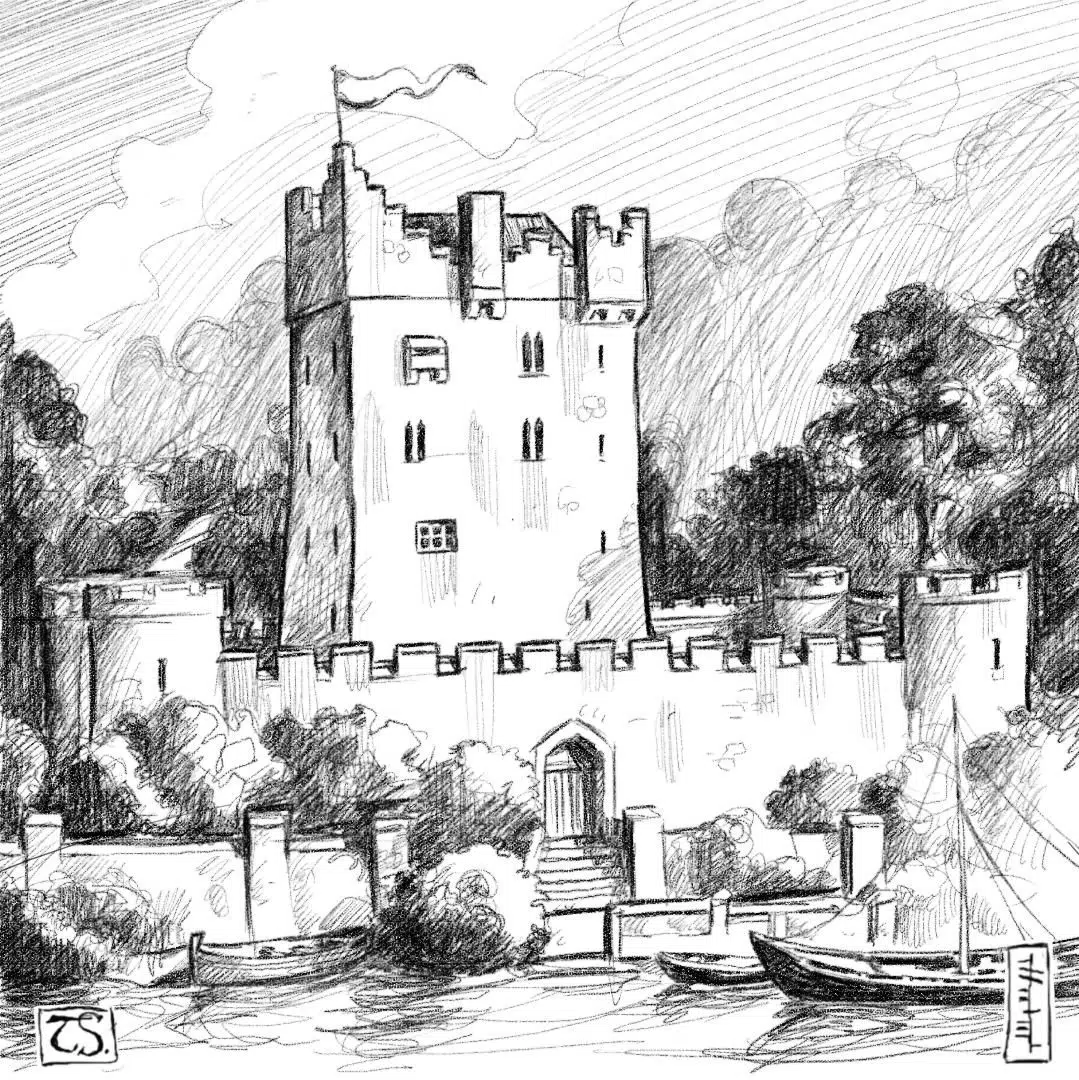
An artist’s impression of the site when constructed. Original artwork courtesy of Tim Spillane.
Origins of the village.
The origins of Ballyhack are obscure. Yet its strategic position on the river must have given it a purpose for centuries before the coming of the Normans.
The placename is perplexing and debated. There are villages of the same name in Dublin, Kilkenny, Meath (2) and of course our own here in Wexford.[iii] Although Bally is agreed as the Irish word Baile for town, settlement, outpost. The Hac or anglicised Hack seems to have no agreed origin.
I have heard it said that the name may be related to Hake – Hake Town. The fisherman in me would like that. And of course the social and economic history of the site right to the present relied heavily on the fishing to sustain the locality. But why an Irish Balie, and an English Hake? The origins seem to be a statistical survey from 1815 by one WS Mason who was quoted by that wonderful collector of fishing related materials Arthur EJ Went. Went in his paper on the Irish hake fishery was interested in the association and thought it credible due to the historic links between a very substantial hake fishery in the harbour in the 16th Century.[iv]
Hore, in his history of the area also mentions Hake, but also suggests that it may be from an Irish word for Sceach or the Hawthorn/Whitethorn bush of which there are many on the hill and surrounding area. He also discusses an early Christian settlement – Baile Canoc, the cell or settlement of Canoc.[v]
Mind you Wikipedia also gets in on the act: “Ballyhack has been represented in Irish as Baile Hac and Baile Each. The derivation is believed to be from the Irish word for stable, seasmhach, and baile, meaning town, village, home or settlement.”[vi]
Early history
That early history was unwritten of course but is it possible that there was an early Christian era settlement in conjunction with a preexisting ferry? Or even before. When Henry II granted a ferry crossing to the Knights Templar in 1171 was he allowing them the rights to an existing ferry crossing, here at the narrowest part of the harbour? I think so. Again although we can’t be certain, without a time machine, its most likely that when the Templars operated the ferry from Passigum (Passage East) it ran to Ballyhack and that there has been a ferry here, in a variety of different forms up the present.
Indeed, it has been recorded that the Templars had a house at Ballyhack from the early medieval times.[vii] The Templar order was dissolved in 1307 and much of their properties and entitlements fell to their bitter rivals, the Knights Hospitaller.[viii]
However, there has been a historical confusion with regard to the extent of the influence of the Hospitallers and Ballyhack. For many years it was assumed that another location on the River Slaney, Ballyhoge / Balischauc was a reference to Waterford Harbour. Perhaps because of this, Ballyhack was assumed to have always been a Hospitaller stronghold.[ix] However, their influence in Ballyhack may not have necessarily been as firm as assumed. They were probably in as fractious a relationship with the Cistercians of Dunbrody as their earlier colleagues, the Templars.
Etchingham era
When religious influence was sundered through the Act of Dissolution (1536-41) much of the lands of Dunbrody Abbey fell, eventually, to Sir Osborne Etchingham, including Ballyhack Castle. According to the late Billy Colfer, Sir Osborne swapped his lands in Suffolk for Dunbrody. A man of influence, he was a high official in the court of Henry VIII, a fourth cousin of Anne Boleyn, and a member of the privy council. He was also Marshal of the English army in Ireland. His son Edward inherited from him, but he died in the Tower of London after some piracy charges associated with shipping in the harbour. John, Edwards’ brother, succeeded him, and he died at Ballyhack Castle in 1616. His grandson, also John, was the last Etchingham associated with the castle, for after he died in 1650 his daughter succeeded him. She was married to Sir Arthur Chichester (some claim at 13 years of age). A descendant of theirs, also Arthur, would become Lord Templemore in 1831 and his nearby home and new village was named for him – Arthurstown.[x]
The family had a connection to Ballyhack up to the late 1600s. One of the archaeological surveys of a pottery find from the garderobe highlighted evidence of maritime links across the continent and underlined the relevance of the location to trade and the connections that existed with the harbour and the continent.[xi] It seems that when they left, the castle was allowed fall into ruin up until the 1970s when the pressure of locals saw it first taken over by the state, later preserved and finally opened to the public initially by the local community and later by the Office of Public Works, as it is managed to the present.
Building of Ballyhack Castle.
There are two theories about the builders. One suggests that it was the monks of the nearby Dunbrody Abbey. Another claims it was the religious order of the Knights Hospitaller of Saint John, a group of Knights who originally cared for those who fell sick on pilgrimage to the Holy Land. [xii]
The Hospitallers took over the properties and interests of the Knights Templar after they were disbanded in 1307. As the Templars had been granted the ferry rights across the harbour by Henry II in 1171, it’s likely the Hospitallers would have gained the ferry rights at that point. They certainly secured the lands at Crooke where they subsequently built a tower house. But Ballyhack was on the lands of the Dunbrody estate. One can only imagine the hostility and intrigue that would have existed between the order and the monks.
Colfer in his Castles of Wexford, firmly concludes that Ballyhack Castle was the work of the Cistercians, essentially a commercial grange, and stated that it was to control the ferry crossing and the lucrative fishing operation that existed in the harbour.[xiii]
Perhaps we will ever know conclusively, but people have their own favourite origin theories. Whether the castle was subsequently built by Dunbrody Abbey or the Knights Hospitallers its likely that a community of about 12 Knights and their attendants lived in and around the castle until mid 1500’s when Henry VIII dissolved all the monasteries and orders in Britain and Ireland.
I came upon this interesting pdf of a floor and castle plan online recently for Ballyhack. Ballyhack Castle Plans

What is known is that much of the stone was quarried from the nearby hill and even the lime mortar has evidence of the local gravel from the riverbank including cockle, winkle and clam shell. Authors collection
Attacks on the castle
Unfortunately, just like the speculation about the builders, little is recorded about the history of the castle. Only one specific historical era is detailed which was the time of the Confederate wars 1641-1652. During that time the confederacy took over the castle and on March 6th 1642 the armed merchantman Fellowship from Bristol, weighed anchor at Duncannon Fort where it was relieving the troops. It sailed up river and off Ballyhack proceeded to bombard the castle. The castle withstood the onslaught and perhaps in frustration, her captain, Thomas Powell ordered his troops ashore but their attack on the castle was repelled and on their retreat back to their vessel they proceed to burn the village. [xiv]
Post publication I came upon the log of the Fellowship, written by Captain Powell. It seems his vessel had been requisitioned as a naval vessel and his normal base was Kinsale. His own words state that they arrived into Waterford harbour on the 4th and anchored off Creaden Head (he spells it Croyden) where the ships skiff carried some crew ashore to gather intelligence. The next day they went up on the tide and anchored with the Lamb of Bristol and the James of Youghal off Duncannon, where poor weather kept them. On the 6th they went up “against Passage” but off Ballyhack he anchored and “battered against Ballihacke fort with little harme”. (elsewhere I read courtesy of Jon Murphy that lots of protestants fleeing Confederate forces were gathered at Passage which he does not clarify unfortunately). On the 7th they sent a party ashore and he says they burnt much of the village, when they returned two had been wounded by musket balls, but not fatally. Suggesting the Confederates either engaged them in the village or as recoded elsewhere, repulsed an attack.
In July of 1642 a disastrous attack was launched on Redmond Hall by troops from Duncannon who landed on the stand below what is now Loftus Hall. Between resolute defence, a counterattack and deteriorating weather, fewer than 30 of the original troop of 90 survived. Some 17 were taken prisoner by the confederated and some of these were later hanged at Ballyhack Castle.[xv] Hore recorded the hangings were ordered by Sir Morgan Kavanagh.[xvi]
1649 Cromwell ordered the castle to be taken as it was a threat to their control of the harbour.[xvii] At this time it is believed that ordnance was brought up onto the Hill of Ballyhack and the southern wall was breached. It’s said that the battlements were removed from the castle following this event – a term called slighting.[xviii] The Etchingham’s later claimed compensation for the damage to their properties [xix] and it’s likely that the repairs that can still be seen on the third and fourth floors in the southern wall of the castle date from this time.
A final footnote to the era is the phrase “to go to Ballyhack” used in relation to the land clearances of landowning Catholics who were sent “To Hell or to Connaught”. I grew up learning that phrase related to the removal of the Aylwards of Faithlegg who were marched to Passage and sent by ship to the west. Similar clearances obviously came to Ballyhack. Many may have been held at the castle, but that’s unwritten. It is also said that many were deported to the West Indies as indentured slaves at this time, again from the area.[xx]

Detail from Thomas Philips plan of the star shaped fort for Passage of 1685 from NLI. Note you can access the hi resolution image from this link.
Likely purposes of the castle
The most obvious connection between the Castle and Ballyhack is its location on the old Ferry route. I have written on the ferry before and so no need to mention it here again except to say that in earlier times the river was located much nearer to the castle and the ferry was most likely controlled on this side of the river from the castle.[xxi]
Ballyhack dominated the river. A vast quantity of shipping was coming into and leaving from the ports of New Ross and Waterford from well before the castle was built. The location was key to shipping in the past. Sailing vessels could reach the location with relative ease, but once you go above here, the rivers narrow, the hills close in and sailing becomes much more of a challenge. For centuries ships probably came only as far as the anchorage outside. There they were lightened, some perhaps were towed into the ports by hobblers, others were loaded again where they lay at anchor. The provisioning of ships must have been a vital service as was the management of customs, taxes, tolls and security.
At the time of the building, a very important herring fishery was taking place in the harbour and off the coast. The topic is well covered in Patrick Hayes’ book Ireland’s sea fisheries 1400 -1600 (2023). Visiting ships from Portugal, Spain, France and England were calling to the harbour, paying for access to fishing and also for the right to land their catch, process it by salting and barreling and storing the catch until they could fill their holds and return home. Money would change hands, but also it is likely that they bartered with salt and wine and there must have been a lot of jobs both fishing and processing.[xxii]
As noted already, Went describes Waterford harbour in the 1500s as a major fishing area, to the extent that Ballyhack could be considered the Town of Hake! He also notes that on the dissolution of Dunbrody Abbey it was recorded that two local Ballyhack boats were owned locally and operated by nine fishermen. These and any visiting fishing craft landing at “le Key” of Ballyhack were “…bound to render one fish out of a catch of large fish; one hake out of a catch of hake and one fish out of a catch of small fish” [xxiii]
Hayes describes how visiting fishermen (and perhaps locals to a lesser extent)needed ground ashore to process the catch. Two principal methods were used at the time – mixing fish such as herring with salt and barreling them. Fish such as hake, pollack or cod were more likely to be split, cleaned and hung of trestles to air dry before being stored.
The castle was, when built, the most likely spot that a visiting ship would call – a large stone-built building dominating the anchorage, projecting out an obvious authority and purpose. Where better to signal authority and control.
It would later be superseded in terms of authority by a new blockhouse at Passage East (1568), sometimes referred to as the Spanish Fort – as part of the defences were built by Spanish prisoners of war.[xxiv] Both would be foreshadowed by the star shaped fort at Duncannon in 1588. Although built to thwart a Spanish or later French invasion, each was also credited with protecting and controlling visiting fishing vessels too.
In 1796 when fears of a French invasion were again focusing minds on the harbour, plans were set to improve Duncannon and Passage East. But Ballyhack Castle, then in ruin, was ignored in favour or a more strategic battery emplacement at Church Point, seemingly never actioned however.[xxv]
Silent witness
As I have already mentioned, much of the history of Ballyhack Castle is unwritten, lost or awaiting discovery in an archive. However, don’t let that deceive you into thinking it was a backwater. Ballyhack was a strategically important and dynamic area as the following may highlight.
For example, the hill of Ballyhack also shared another important, but alas no longer extant, building called the Temple of St James. Listed on charts for sailing purposes into the harbour, it was later eclipsed by the Spit Light. Damien McLellan has traced a possible link between the church and others connected to a medieval pilgrim route to A Coruna in North West Spain and the Camino de Compostela. Did medieval pilgrims call to the castle for rest, security and food– it is surely feasible.[xxvi]
According to an article by Sean Pierce[xxvii] the first church was a mud and stone building that was situated where the cluster of yew trees can now be found in the graveyard of Ballyhack. The building was destroyed by the Cromwellians. A later church was erected by the protestant faith and this was removed in 1876 when a new church was constructed at Blackhill. I was told locally the building was used as the foundation for the new building.
Ballyhack Fairgreen was situated behind the old church and the present graveyard. A recording in the school’s folklore collection gives the following details “The ancient fairgreen is adjacent to the old church and is one of the feudal appendages of Ballyhack that was given by royal charter to the Abbey of Dunbrody in the time of King John. In the reign of James the first it was given by royal grant for public use, free of all tolls and customs.”[xxviii] There were a number of fair days every month but the principal fair days were said to be on the Feast of St James July 25th and Michaelmas on September 29th and the coming of Autumn. I have no further info on this as yet however.
The old Quay or ‘Le Key’. I described the current quays above but a sketch by Thomas Philips from 1685 shows a broad sweeping quay area along a similar footprint to the present main quay and road to the hill.[xxix] Who knows how many iterations of this harbour development there were. Recently I came upon a local placename on the road up from the quay towards the castle – Lackey Street. It may be Le Key from the French– The quay.[xxx] For centuries, people of the area have worked and made a living from the sea, seafarers that sailed the world’s oceans, fishermen who worked damn hard to earn a living and in more recent times Carrolls boatyard, now closed, but the makers of fine sturdy wooden vessels that were synonymous with the village and its heritage.
Ballyhack was also synonymous with the harvesting and transhipment of millstones. It’s a topic I have covered previously on the blog which you can view if you please.[xxxi] Suffice to say the trade was so identifiable with the village that they were marketed as Ballyhack Millstones, not just locally but throughout Ireland and were also exported to England. ( I have found newspaper adverts from 1750s to 1852) I always wondered the age of this operation. Was it to here for example, the monks of Dunbrody came to harvest the first stones used to grind corn in the salt mills of the abbey. Most likely. A trade then that spanned from 1200s-1850s.
Much has been written about the Newfoundland fishery and its connections with the harbour. In 2005 I was in conversation with a Newfoundlander to the area and he mentioned that some taxi drivers in his home town of St John’s would ask if you wanted to get out of the cab on the Passage or Ballyhack side of the street. He never realised the significance until he visited the area. I have no idea if this saying was true, but it makes a great story and it certainly rings true, historically. Merchant ships, emigrant ships, warships and even leisure craft would gather in the anchorage awaiting the weather to change and favourable winds. Its a reality I have covered many times on the blog. I’m planning another post soon on just such a specific topic from 1862.
Again related – another blog I have in progress is on the famine ships of 1847, which departed in convoys from off Ballyhack between April and September. The convoys were simply the clustering of emigrant ships off the village awaiting a favourable wind. What you might find amazing is that many times these vessels were reported at Grosse Isle quarantine station in the St. Lawrence, below Quebec as arriving on the very same day. Astonishing as it sounds, my guess is that they were similarly sized and rigged, and departing together, they caught the same winds and endured the same weather stresses or fortunes while they crossed the Atlantic – some in as little as 30 days, although others took almost twice as long, with many more fatalities as a result. I can’t imagine these poor souls cared much about whether it was Passage or Ballyhack they sailed from however.
Other times they waited in convoy for protection from pirates as a previous blog on the travels of William Brearton explained – almost fifty vessels awaiting the tide, the wind and a royal navy escort before sailing to Bristol. The convoy was to protect the ships from Barbary pirates.[xxxii] The people must have awaited boarding on both sides of the river.
Its history is recorded in other ways too. Hore lists a number of mentions from medieval sources. In 1395, for example, a merchant of Ballyhak – William Ilger was fined for selling salt, iron, hides, cloth etc at Ross without paying any custom duties.[xxxiii]
In 1442, an inquisition was held at Balyhak before John Wyche, a baron and John Ffrench, kings commissioner.[xxxiv]
In 1542 a grant (of office?) was made to John Morton office of gauger and searcher at the ports of Rosse, Ballihacke and Downecannon[xxxv] ( a role associated with duties on goods) In 1550 another John – Gregory seized a ship called the Swan of Bristol between “Ballyhake and Dunkanen” for exporting wool without paying the dues owed. Two years later 1552, Peter Smyth (He surely was the son or brother of a John!) seized an unnamed ship at “Ballyhacke” for an unidentified crime. [xxxvi]
Elsewhere in 1689 we learn that a captured ship the Mary of Ballyhack (master George Mead) an Irish merchant ship (20 tons) bound from Ballyhack to Plymouth, laden with beef, butter, tallow, hides and frieze; taken on 20/30 May 1689 in Mounts Bay by customs officers, and brought into Plymouth, after they found a ‘scandalous paper’ in the possession of a member of the crew, which caused them to suspect he was Catholic and possibly Jacobite.[xxxvii]
To conclude, in 1684, Robert Leigh gave the following description:
“About two miles from Dunbrody to the sewarde upon the river of Waterford there is a creeke and an old Key at the bottom of a steepe rocke, called Ballihack: it is a sad place to looke upon, and has not above halfe a dozen houses and an old pile of a castle besides a fue cabins, but is is a place much frequented by passengers that ferry over there into Munster to a place on that syde called Passagem as alsoe by seamen and the like, for ships often lye thereabouts in the River.
There are two considerable fairs kept at Ballihak, (for black cattle and hogs) in the yeare, the one at Michaelmas, the other upon St James’ day.
In summer and out of the rock that hangs above ye village and Key is wrought a number of very good Milstones, which with noe small skill nor less danger are rowled downe a very high precipice to the aforesaid Key and soe carried by water as the occasion requires”[xxxviii]
So, what you will presently see if you visit the castle?
There are many defensive features to be seen on this tower house.
The entrance door (only way in or out) is positioned 1 meter above ground level. While we now have oaken-planked entry steps, in the past, it probably had a ramp or makeshift steps for entry that could be removed when under attack.
There would have been an iron gate called a Yett- like a portcullis in front of a thick oak door. The recess is still to be seen. Machicolation projection from the 4th floor, rocks, hot oil or hot sand, perhaps could be dropped on those below. On the SW corner, the projecting stones of a Bartiza. Battlements would have been a feature until Cromwell removed them in the 1640s. Finally, the walls splay out towards the base. This exposed attackers and provided structural support for the tower.


Bottom floor
As you enter, look for the medieval CCTV system – a murder hole above the hallway from where uninvited guests would get a quick dispatch. There are four floors in this castle or fortified tower house as it is more properly described. The bottom floor was used for defence and storage. Servants slept in the recesses (or embrasures) on beds of straw. The walls are 10 feet thick for protection against a battering ram. Arrow loop windows designed to make defence easy and attack difficult, can be seen on the floor. A reconstructed ceiling made of oak laid on corbels are seen above. The doors are hung by a “hanging eye” and a “spud stone” hinge system.
First floor
As you go up, hold the rails – the steps are designed to trip you up! The barrel vaulted ceiling is the most distinctive feature of this room. Used for fire protection, it was made of wicker work, like basket weaving, rested on corbels and then supported with mortar. The long channels in the ceiling is the remains of the stick that has since rotted away.
Second floor
Living quarters. From the corbels, you can see where the ceiling and next floor would have lain, i.e., on top of the corbels. The murder hole was located at base of window seat. Ogee window arches over look the village and river, an oriental style brought from the Middle East.
Garderobe (toilet) chamber cut into the wall of the castle. It was the job of the gangpit farmer to clean it. They hung their clothes on rails here, in the belief that the toilet stench would kill the knits and insects that crawled into their clothing. When the castle was built, the dwellers didn’t wash much as they believed dirt would act as a barrier to disease. Aristocrats, for example, Queen Elizabeth or Sir Walter Raleigh, used to wear high ruffles which were heavily perfumed so that they wouldn’t smell their own bodies or others.
Adjacent to this is the Oubliette (meaning forgotten people) dungeon. Only one entrance in or out. No bones found here, so it may have been a secret room for valuables. However, it’s history may also be as grim and dark as the room suggests.
Upper Floor
Our final floor is accessible via a spiral staircase and it houses a small chaple with altar stone. It confirms a religious as well as a military order. It includes a Piscine: where they washed vessels. Aumbry: a cupboard for storage of chalice etc and my favourite detail, Corbel candle holders. Glass reveal in window frame, possibly painted or stained glass. The only window with glass in Ballyhack Castle. Two little rooms complete the floor, the Vestry and another Garderobe…note the candle holder.

There would have been other floors originally, one of which included a wall walk on top of the battlements.

And as you leave, look out for the two faces on the walls…one Christian, the other this pagan carving, known locally as Cromwell. An original drawing by my fellow guide, Tim Spillane
Later history
Despite being abandoned in the late 1600s[xxxix] Ballyhack has withstood the elements.
Newspaper archives highlight a prolonged and diligent effort by locals to bring attention to the deterioration of the building in the 1960s. Time and again politicians were approached and a case made from a health & safety point of view. In 1965 the New Ross Standard reported that the castle was going to be acquired by the Board of Works.[xl] However in 1970 the Ballyhack & Arthurstown Development Association were again campaigning, this time to get the Board to get to work! In July of 1971 Noel T Lemass TD was quoted in the Standard as saying the funding had been allocated and works would commence soon.[xli]
In 1992 the South West Wexford Partnership published plans for the opening of the castle to the public, the Office of Public Works had cleaned the building, and floodlighting was to follow. Two jobs were proposed to be created in making the site accessible to the public. The location of the car ferry was seen as a key driver. The floodlighting was officially launched on St Patricks Day that same year.[xlii]


A number of local initiatives from tourism, heritage courses and other events were hosted over the next number of years at the castle or at an old cottage donated by Michael Foley. In 1997 the Office of Public Works advertised for staff to provide a summer guiding service, and with some breaks due to covid and essential works, it is still providing that function to this day. Given that so many of the tower houses now lie in ruin or are inaccessible, the very fact that the building still stands and is open is a testament to the fine people of the village who fought hard for their castle.
Conclusion
Whether it is wars, atrocities, emigration, pilgrimage, seafarers and pirates, fishermen and nobles, paupers and priests, the Ballyhack and its castle location has seen it all. Tucked away in the lee of its hill, Ballyhack Castle endured as the world changed and adapted, nations rose and fell, warriors fought and died, women gave birth, and new generations progressed.
Within its walls lies a snapshot of history. So much more can be considered or imagined, retold and reflected on from this historic and strategic base on the river. A location where Ireland’s fortunes ebbed and flowed like the ever-changing tides at the foot of Ballyhack Castle’s walls.
So if you get a chance call in over the summer months. Tim (my fellow guide) and I will be only too happy to welcome you, give you some detail or even show you around. But you are free to explore on your own too. Check out the OPW website for any other sites and our opening times too.
My thanks to Tim Spillane for the support with this. I have also had information from many people locally, too many to mention but Martha White, Breda Lynch, Shane and Dermot King, Liam Ryan, Jon Murphy and John Flynn have all gone out of their way to be helpful amongst others. All errors and omissions are my own, and apologies in advance for my sloppy referencing…I wanted to stand over the information but ran out of time to cover it off prior to publication. Although we struggle to find information on the castle, we are always open to clarifications and extra information if you have any to share.
Tides & Tales
We are a community-based initiative, created with passion, sustained by curiosity, and kept afloat by the support of readers like you. Thanks for taking the time to read this account.
Endnotes
[i] For more on the location see for example https://eoceanic.com/sailing/harbours/82/ballyhack
[ii] A good resource is Pierce, JW. (1985) Arthurstown, The Story of a Village. Self Published booklet.
[iii] Accessed on Fri 22nd May 2026 at 16.43 from https://www.logainm.ie/en/s?txt=ballyhack&str=on
[iv] Went, AEJ. The Irish Hake Fishery 1504-1824. Cork Historical and Archaeological Society. 1946, Vol 51, No 173, pp 41-51
[v] Hore.P.H (1901) History of the Town & County of Wexford. Dunbrody Abbey, The Great Island, Ballyhack etc. London pp 205-213 p241
[vi] Accessed Friday 22nd May 2026 17.36 from https://en.wikipedia.org/wiki/Ballyhack,_County_Wexford
[vii] Fanning. T, Hurst JG & Lweis JM, A Mid-Seventeenth Century Pottery Group and Other Objects from Ballyhack Castle. Co Wexford. Proceedings of the Royal Irish Academy; Archaeology, Culture, History, Literature, 1975. Vol 75 pp 103-118. (see specifically page 103)
[viii] Byrne N. (2008) The Irish Crusade: A History of the Knights Hospitaller, the Knights Templar, and the Knights of Malta, in the South-East of Ireland. Linden Publishing. Louth. pp100-110
[ix] Ibid p251-2
[x] Colfer, B (2004) The Hook Peninsula. Cork University Press, p 217
[xi] Fanning etc (1975)
[xii] Accessed on Friday 22 May 18.28 from https://heritageireland.ie/places-to-visit/ballyhack-castle/
[xiii] Colfer, B. (2013) Wexford Castles: Landscape, context and settlement. Cork: Cork University Press. see p 152 & 155-6 for example
[xiv] Murphy, E. (2012) Ireland and the War at Sea, 1641–1653. Royal Historical Society Studies in History New Series (Vol. 85). Woodbridge: Boydell & Brewer. See p 19
[xv] Colfer(2004) p95-6
[xvi] Hore (1901) p 249
[xvii] Ibid
[xviii] A reference needed for Cromwellian attack on Ballyhack and slighting
[xix] Colfer (2004) p95
[xx] To go to Ballyhack quote – Colfer (2004) p 101. Further specifics in Colfer (2013) P 211
[xxi] From Oar to Engine – 900 years of the Passage East Ferry. https://tidesandtales.ie/from-oar-to-engine/
[xxii] https://tidesandtales.ie/irelands-sea-fisheries-1400-1600/
[xxiii] Went (1946) p137
[xxiv] https://tidesandtales.ie/spanish-fort-at-passage-east/
[xxv] Paul Kerrigan. Castles and Fortifications in Ireland 1485-1945. 1995. Collins Press Cork. P?
[xxvi] Accessed 22 May 2026 at 18.18 from https://historyireland.com/reclaiming-irish-way-st-james/
[xxvii] On the Hook Vol 5. Number 1. 2026 God’s Acre – A visit to a cemetery, John W Pierce (first published in 1997)
[xxviii] Accessed on Friday 22nd May 2026 at 17.24 from https://www.duchas.ie/en/cbes/5009231/5000258
[xxix] Colfer, (2004) p61
[xxx] Medieval Wexford. Essays in Memory of Billy Colfer. I.W. Doyle & Bernad Browne Eds. (2016) Four Courts Press. Dublin.
[xxxi] https://tidesandtales.ie/the-millstone-era-in-waterford-harbour/
[xxxii] https://tidesandtales.ie/waterfords-st-james-day-flotilla/
[xxxiii] Hore (1901) p 246
[xxxiv] Ibid p 247
[xxxv] Ibid p 248
[xxxvi] Ibid p 248
[xxxvii] Accessed 21/05/2026 15.33 from https://discovery.nationalarchives.gov.uk/details/r/C18063266
[xxxviii] Hore (1901) p250
[xxxix] One suggestion is that it may have been unoccupied from the 1660s
[xl] New Ross Standard. Saturday 20 March 1965
[xli] New Ross Standard. Saturday 3 July 1971
[xlii] New Ross Standard. Thursday 12th March 1992
A brilliant article Andrew and a very impresive list of references. This can be a benchmark for further exploration of Ballyhack. We are lucky to have you in the Estuary. Keep up the good work
Thanks Mark – that was my intention for including them
An interesting article that highlights a local gem and the difficulty in researching its past. Well done Andrew!
Thanks Kathleen, hopefully some other details will emerge subsequently, one benefit of being in the castle is that people call in, share stories and in some cases resources – I got a loan of a locally made DVD on Saturday which may be useful
That actually and not surprisingly mess a great read, full of different information that I did not know.
I even got a mention / “OAP’s free on the ferry”
One other point I wonder about.. I never learned Irish as being absentee most of the time .. But when you were describing the word “Ballyhack” I remembered the Irish word for ‘mouth’ being bhéal could that possibly be related to the mouth of the harbour ? I’m probably talking rubbish as usual LOL
certainly the geographical features of an area are often a main link to the present name Kev…I read since that one theory was the town of hatchets…so yours is a lot less bizzare 🙂
Crazy colloqiuial stuff.
Enjoyed the article and enjoyed our tour just about a year ago!
Thanks for calling Ann, it was great to see you and your family
Very well constructed article Andrew on the Hack , as a former Guide there it has brought back a lot of cherished memories , great work as always by Tim on the illustrations , reassuring the Tower is in very capable hands going forward to tell it’s unique Story of its mysterious past .
A great treasure to have for future generations indeed , commendable works recently carried out by the OPW will help secure it’s future and keep its history alive . keep up the good work guys.
Thanks Frank, you invested a lot of yourself there too…we are standing on the shoulders of giants