
A journey from the Saltees to Waterford city by steamer in 1888. Taken from the book A Trip to the South of Ireland by John Otteran Downey
WATERFORD HARBOUR, RIVER AND CITY
If daylight serves, our tourist friend may conclude that he sniffs as well as sights land on the nautically conveyed assurance that the Saltee Islands are right ahead. Sir at same time will be much impressed by repeated mention of the Connybeg(sic) Light ship, the Brandies Rocks and the Hook Light house as this cluster of objects is being rapidly brought within measurable distance by the good steamer upon which he finds himself being conveyed.
 On reaching the Hook Light house the vessel’s course is observed to alter from a westerly to that of a northerly direction and now Waterford Harbour with its expansive and far reaching surface is seen to full advantage, being bound on the east by the County Wexford shore and on the west by the County Waterford.
Almost immediately opposite the Hook Light house is Dunmore East with its pier and light house, its pilot cutter and hovering yachts and fishing craft and by the way, one of the best health resorts on the Irish coast.
The steamer is now rapidly nearing Creaden Head a conspicuous promontory Cooleenastra Bay [haven’t heard this before?] Woodstown with its beautiful demesnes and convenient strand all on the left while the bluff headland of Broomhill, Duncannon Strand and Fort form the parallels on the right.
Following these on a north westerly bend is clearly visible the Passage Spit Light house supported by tall iron spindles and presenting the appearance in a fanciful way of a huge spider and beyond this is Passage East pilot station and village crowned by a high hill with Crook (sic) forming the back ground.

Spit Light, Passage East in the early 20th C
Right abreast of Passage with which it is connected by a ferry stands Ballyhack a place that has obtained an undeserved reputation for producing butter of a kind the opposite of prize winning. Ballyhack also contains a castellated ruin built at the base of an abrupt hill. It is the most accessible and convenient point for tourists to reach the imposing and interesting ruins of Dunbrody Abbey and also Dunbrody Park the property of Lord Templemore. A fine view of Dunbrody Abbey can be had from the steamer’s deck after about five minutes steaming further on from Ballyhack including en route on the right the unpretentious and harmlessly styled Buttermilk Castle.
After the steamer has passed the Abbey, is met the broad sheet of water formed by the meeting of the rivers Suir Nore and Barrow whose contributions here mingle and flow seawards. Snowhill mansion and grounds on the right and Fairyhill [Minaun I am guessing?] and Faithlegg grove on the left overlook the neat little hamlet of Cheekpoint with its landing quay and salmon weirs.
Cheekpoint is a favourite pull from Waterford in pleasure wherries. The remainder of the voyage to Waterford lies through pleasant margins of cultivated land disclosing Faithlegg House on the left, Glasshouse mill and Belview mansion on the right after which appears the Little Island as if intercepting further progress. The Little Island is centered between the counties Waterford and Kilkenny, the easterly or short passage of which is the Queen’s Channel deepened of late years and this is the highway for all the shipping bound to or from Waterford.
The branch of the river which courses around the Island in a westerly direction is the King’s Channel but being circuitous and narrow at some points although of good depth is never availed of now. On the Island is a castle which may be descried through the trees and the Island is connected with the mainland by a ferry.
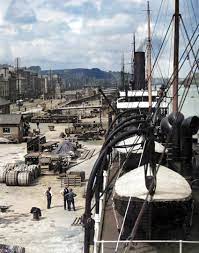 On the upper end of the Queen’s Channel on the right is Gyles Quay and on the left the King’s Channel before mentioned after which is a straight bit of river as far as the Cove Cottage where a well defined curve takes place in a north easterly direction and simultaneously appears the first view of a part of Waterford city including Christ Church spire and portion of the shipping another five minutes and Waterford Quay (Adelphi Wharf) is visible the first objects in approaching which are the Neptune iron works cradle of the four masted iron decked monster steamship Iowa (launched in 1863) of the Atlantic service and opposite is Cromwell’s Rock and stone seat or chair.
 The Waterford Coat of Arms bears the dubious inscription Urbs Intacta Manet and now stretched before the gazer’s eye is a river unrivalled in depth width and symmetrical outlines and quays, where once floated in peaceful competition, the flags of all nations in the home and foreign trade. Facing Waterford Quay is Ferrybank, where also once flourished timber ship building yards, smithies shops and patent slip and from which emerged the magnificent Australian clipper ship Merrie England (built at Whites and launched in 1856) and companions of the foreign service but this industry too has been overtaken by the blighting effects of altered times and circumstances and nothing but the record of past achievements remains.The steamer being now berthed at Waterford Quay the next rub is to know what to do with one self as the difficulties of forming a definite programme unless previously fixed upon are usually a little perplexing to strangers.
Without endeavouring to influence anybody dreading the terrible consequences of disappointing expectations it is best to observe that the services of the local and general Railway and Steamship routes are obtainable from the monthly guide books with maps and advertisements usually to be found on the cabin tables of the Steamers also may be seen at the Hotels or purchased at the stationer shops and at the Railway book stalls.

Paddle Steamer plying the river mid 1850s – sketch by George Victor du Noyer
The Irish monthly guides of course contain a vast amount of current miscellaneous information essential in travelling from place to place. Waterford City is in direct communication by different lines with Dublin Cork and Limerick therefore with all parts of the country and the Irish, English, Welsh, and Scotch cross channel ports. Waterford is further supplied by a very varied and extensive cross channel and river steam service a matter of great importance to tourists and others.
The following tips may be of some use in selecting a day’s outing if time is a consideration to tourists. The index to this little hand book will materially assist in expediting reference to its contents In Waterford a walk or drive along its Quays one mile in length and a view of its Churches, Custom house, Banks, Town Hall, People’s Park with an ascent to the Newrath Hills across the Bridge (toll ½ d each way) to obtain a good view of the City and the River from the north will absorb a few hours of not uninteresting recreation; or by taking the Ferry Boat at Adelphi Wharf (toll ½ d each way) may be viewed the Boat Club House and Grounds attached and Cromwell’s Rock, which latter commands a delightful view of the river and Quay. There are several pleasant drives about Waterford not enumerated here but which may be readily ascertained if inclination suggests enquiries. It is a mistake to spend too much time viewing the same objects if time be limited when there is such a large bill of fare before the visitor…
0 Comments