
At a recent event to unveil an interpretation board at Old Faithlegg Church, my daughter Ellen and I were assisting Damien McLellan with the set up. While we put the world to rights, we fell to discussing the perplexing question of why a large doorway was on the north side of the church when there was a perfectly adequate door for access not ten feet away. Damien had a theory, and this blog sets his thinking out. Over to you, Damien McLellan –
While preparing for the unveiling of the new Interpretative Board in the medieval church in Faithlegg, I wondered again about the original purpose of the present main entrance, a large, neither Gothic nor Romanesque, arched opening on the north wall. Why was this necessary when there was the west entrance, facing in the direction of Faithlegg House?

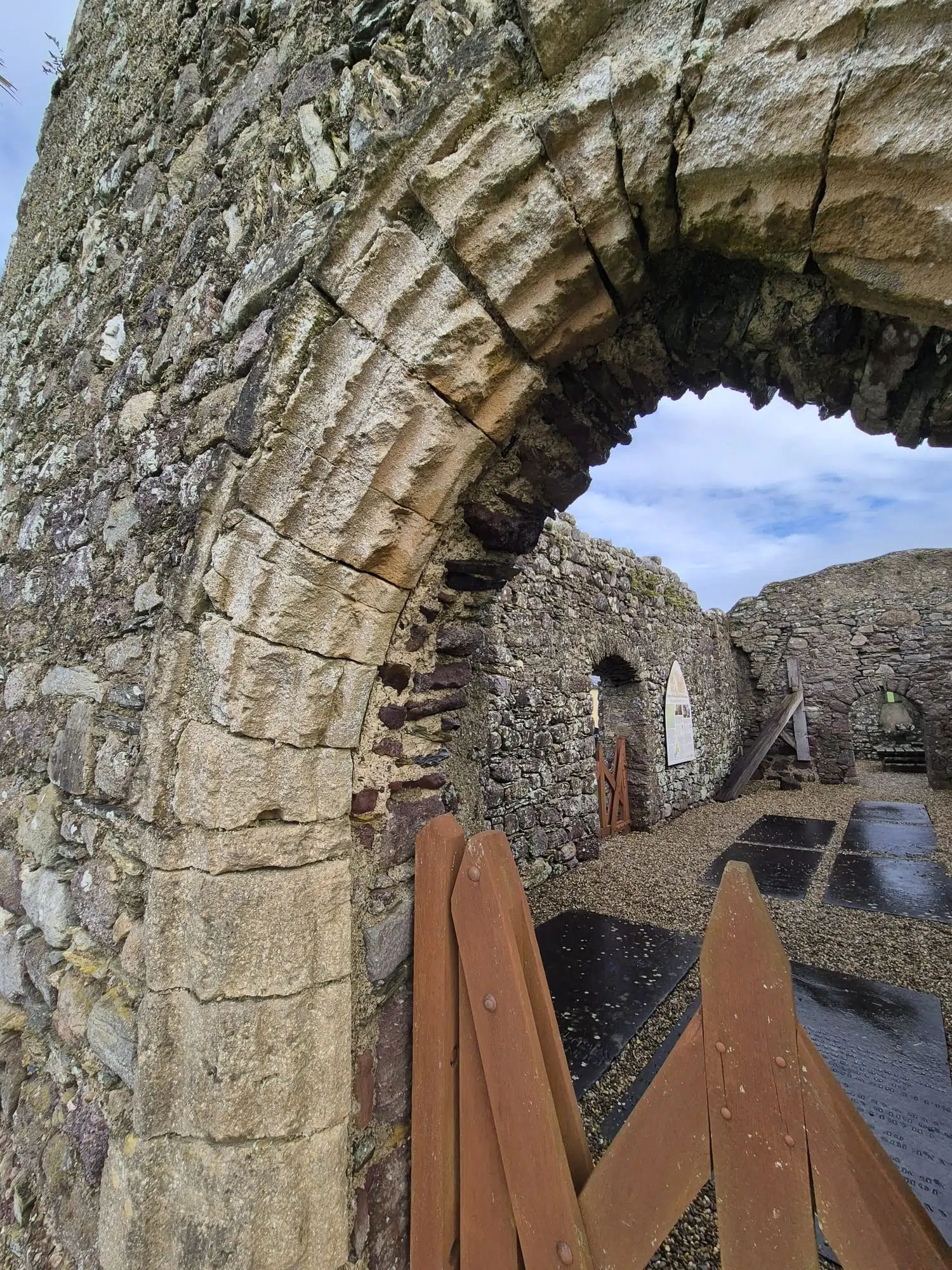
The very wide north-facing doorway – a later addition?
Andrew Doherty and his daughter Ellen were also present, preparing for the Big Day and I asked Andrew to stand with me in the doorway. There and then it dawned on me that this door, and only this door, made it possible for coffins to be carried in for burial within the walls. The very large tombstones could only have been manhandled through this doorway and so was probably created for these purposes. Were the medieval windows blocked up at this time, also, to strengthen the roofless structure?
The oldest tombstone, the middle of three nearest to the west door, is over the resting place of William Bolton who was buried in 1750. Could William have chosen his grave site and anticipated the access problem and had the northern doorway created? It measures 57” wide and is 90” high, while the western door is only 44” wide and 77” high, impossible for six men to carry a heavy oak coffin through.
The tastefully constructed western doorway with Dundry stone carving. Note the gravestones on the floor.
During the rescue of the old church the old cast iron gate was replaced by the present oak gate, but part of the hinge remains in the opening. Cast iron gates came into existence in the 1750s, so the old gate may have been the original one fitted on the instructions of William Bolton.
We should be glad of this doorway, because the easier and much less expensive alternative was to enlarge the west door which would have destroyed the beautiful 13th century pale yellow Dundry stone work. Dundry stone came from Dundry Hill, near Bristol, where, coincidentally, the Alwards came from. This high-quality Jurassic limestone was imported because, unlike our indigenous red sandstone, it was ideally suited for decorative carving.
I like to think that as the invading Aywards may have intuitively built their first church on the site of an earlier structure, that their successors, the Boltons, in their own way, respected the old church and so left it for continuing generations to appreciate.
Tides & Tales
We are a community-based initiative, created with passion, sustained by curiosity, and kept afloat by the generosity of people like you. If Tides and Tales has informed, inspired, or simply entertained you, there are several meaningful ways you can help us continue our work.
- Share this story with a friend, family member, or colleague.
- Leave a comment with feedback.
- Subscribe below to stay connected with our latest content.
- Other ways to assist financially if you can, include;
Donate—even a small contribution helps us keep the stories flowing.
Visit our shop and consider a purchase; all proceeds directly support the project.
Every positive action, big or small, helps us to keep Waterford Harbour’s rich maritime legacy alive and accessible for generations to come. Thank you for being part of the journey.
Great info