
“Tram and Ship Collide”
“A tramcar and a schooner came into collision in Dublin yesterday. The tram was crossing Victoria drawbridge on the Ringsend line while a three masted schooner was being berthed in the Grand Canal Company basin, which is spanned by the bridge. The spars of the schooner overtopped the bridge and smashed the window of a passing tram. Nobody was hurt”.
This small news item appeared in The Irish Times of Tuesday, November 29th, 1921. A similar short report appeared in the Irish Independent on the same date. The ship was the schooner Cymric. The operator at the bridge, now known as McMahon Bridge, had decided to allow the tram to cross the bridge and signalled this to the schooner, but she was suddenly blown forward by a gust of wind and her bowsprit speared the lower saloon of the passing tram. A window was broken, but fortunately, there were no injuries.
By a strange coincidence, twenty-two years later, on December 21st, 1943, another Arklow schooner, the Happy Harry, had a collision with a tram at the same location, which caused a delay to traffic. Writers continue to confuse and conflate these two separate incidents, often adding incorrect dates.
The unfortunate incident experienced by the Cymric in 1921 would be one of many such misadventures that would beset this ship over its lifetime, one that would have a very tragic and sad ending.
The steel-hulled Cymric was built at Amlwch, Anglesey, North Wales, in the yard of Captain William Thomas and was launched in March 1893. Originally built as a barquentine, she was later rigged as a schooner when she came into Arklow ownership in 1906. The Cymric and her sister-ship, the Gaelic, built in 1898, were the last survivors from the shipyard of William Thomas.
The Gaelic was wrecked on the Donegal coast in February 1952 on a voyage to the Mersey with a cargo of silica sand. Another sister-ship, the Celtic, built in the same yard in 1894, had a shorter life. On a voyage in August 1907 from London to Oban, in Scotland, with a cargo of cement, under the command of her owner, Mr J Hall of Arklow, she encountered an unseasonable gale and was wrecked in the Orkney Islands. All the crew were saved.
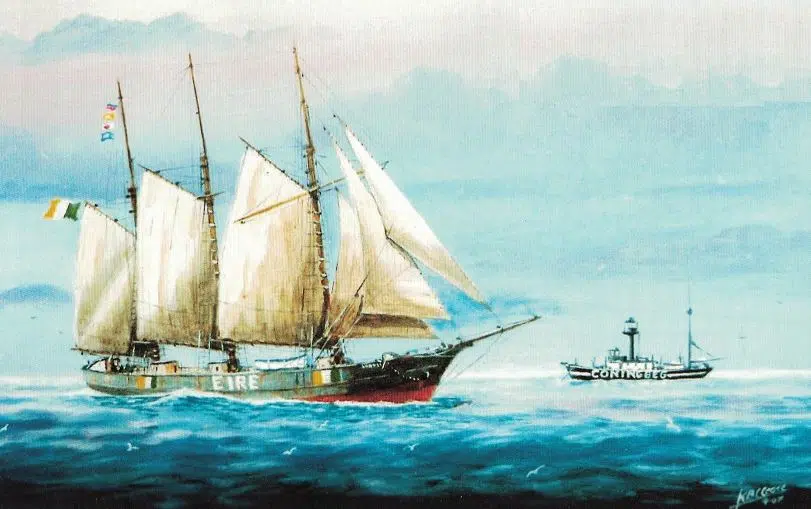
This painting, courtesy of Maritime Artist Brian Cleare, depicts Cymric, with her neutral signage and identifying herself to the Coningbeg Lightship by displaying her signal letters E.I.F.P. as she passes.
In April 1893, her maiden voyage, under Amlwch man, Captain Robert Jones, took her to the Brazilian port of Porto Alegre and home to Runcorn. This would be a regular run for the next six years under Captain Jones. In 1899, J & S Holt of Liverpool bought her for the sum of 2,650 pounds, a good price at the time. In 1906, Holts sold her to Captain Richard Hall of Arklow, the port where she would spend the rest of her career.
During World War I, the Admiralty requisitioned the Cymric, along with two other Arklow schooners, Gaelic and Mary B Mitchell, to be used as Q-ships. Q-ships were heavily armed, disguised decoy merchant vessels used to lure German U-boats into surface attacks, only to surprise them with hidden firepower. To help the Cymric in her naval duties, two engines were installed.
Cymric had the misfortune to sink a Royal Navy submarine in error. On October 15th, 1918, HMS J6, a J-class submarine, was on the surface outside her base at Blyth in Northumberland, when she was spotted by Cymric, which mistook her ‘J6’ marking for ‘U6’, a German submarine. Cymric opened fire and J6 tried to signal, but in vain. J6 fled into a fog bank, but Cymric located her again and sank the submarine, with the loss of fifteen lives. Nineteen survivors were picked up by Cymric.
After the war ended, Cymric returned to Hall’s of Arklow and traded mainly on the Irish ports to Bristol Channel. She was a frequent visitor to many coastal ports around Ireland including Waterford and New Ross.
County Wexford proved to be an inhospitable coastline for Cymric. On August 22nd, 1922, Cymric struck the Brandies Rocks, a pair of rocks south of the smaller Saltee Island, near Kilmore Quay and had to be beached. It took two-days before she could be re-floated. In January 1924, Cymric, with a cargo of bricks, went aground again, this time at Rosslare, and bad weather hindered the task of lightening her in the hope that she would float off, took a considerable time. On Christmas Eve, 1933, Cymric, when sailing to Dublin with a cargo of malt, again went aground, this time on the treacherous Bar of Wexford Harbour. This happened after her propeller was fouled by a rope that had been left in the water that had been used in a failed attempt by the steamer Elsie Annie to tow off the Danish schooner Svanen, which had gone ashore on November 15th. It would be January 5th, 1934 before Cymric was refloated.
At the outbreak of World War II, Cymric’s trade patterns changed. The Irish shipping register contained only fifty-six ships, fourteen of these were Arklow schooners. Cymric and the other Arklow schooners, often aged and wooden, were essential for carrying coal and other goods during the years known as the ‘Emergency’, 1939-1945.
United States President Roosevelt signed a law in November 1939 that stopped American ships from entering the “war zone.” This zone was a line from Spain to Iceland. Goods meant for Ireland were sent to Portugal. It was up to Irish ships to pick them up there. This route became known as the ‘Lisbon-run’.
Sailing from Ireland, ships would carry farm products to UK ports. There, they would unload their cargo, get fuel, pick up a British export (often coal), and take it to neutral Portugal. Courageous Irish ships, with ‘Eire’ painted on their sides to display their neutrality, on the ‘Lisbon-run’, would carry vital supplies home from Spain and Portugal, as well as goods transhipped from the Americas.
Cymric had a re-fit at Ringsend Dock in October 1943 and on New Year’s Day, 1944, she arrived in Lisbon with a cargo of Welsh coal under the command of Captain Christopher Francis Cassedy, who had only recently taken charge, due to the illness of Captain Cardiff. (For further details on Captain Cassedy see comment section). The passage home was a rough one, with several of her sails being blown to pieces in the Bay of Biscay, but she did get home, arriving on January 24th. Cymric was again put into Ringsend Dock for a re-fit to get her ready for sea again.

Cymric crew at Ringsend Dockyard, Dublin, September 1943. Photo: Cormac Lowth Collection.
On February 23rd 1944, Cymric left Ardrossan, in Scotland, with a cargo of coal for Lisbon. The following day she called into Dublin for a barrel of lubricating oil, possibly for her auxiliary engine and then headed out into the Irish Sea again. But the Cymric never made it to Lisbon and nothing was ever heard of her crew of eleven and was posted missing.
Lost on Cymric:
- Master: Christopher Francis Cassedy, (59), Monkstown, Co Dublin
- Mate: Bernard Kiernan, (41), Dundalk
- Bosun: Peter Seaver, (35), Skerries
- First Engineer: Michael Tierney,(42), Wexford
- Second Engineer: Kevin Furlong, Wexford
- ABs: William O’Rourke,(67), Wexford, James Brennan,(59), Wexford, James Crosbie, (66), Wexford.
- Seaman: Cecil McConnell, (22), Clonskeagh, Dublin
- OS: Philip Bergin, (18), Wexford
- Cook: Michael Ryan, (45), Dungarvan
The sighting of Cymric off Dublin on February 24th was the last that was ever seen of the gallant little ship and her crew, and the cause of her disappearance remains unknown to this day. She disappeared without a trace and was posted as missing, lost with all hands. No wreckage was ever found. She might have hit a mine, been sunk by a U-boat, lost in a gale or attacked and sunk by aircraft.
Further misfortune would befall the McConnell family later in 1944. On October 2nd, when Carina, a successful 21-foot, Bermuda-rigged yacht disappeared off Howth Head, with the loss of her crew, while sailing from Skerries to Howth to lay her up for the Winter. On board was Jack McConnell,26, a brother of Cecil, lost on the Cymric, and his crew Ken Martin, 23. Cecil McConnell, a co-owner, and Peter Seaver of Skerries, also lost on the Cymric, had sailed on the Carina.
Liam MacGabhann, a leading journalist and a member of Skerries Sailing Club wrote a poem to remember the loss of the sailors. The poem was displayed in Skerries Sailing Club and published in the Irish Press.
The second-last verse is dedicated to the Carina and her crew:
And so we still set spinnakers, and make the runners fast,
And keep the good craft sailing still, though she be first or last
Yet scarce an evening passes but someone’s sure to say.
“Ah, but to see Carina now, come sailing down the Bay”.
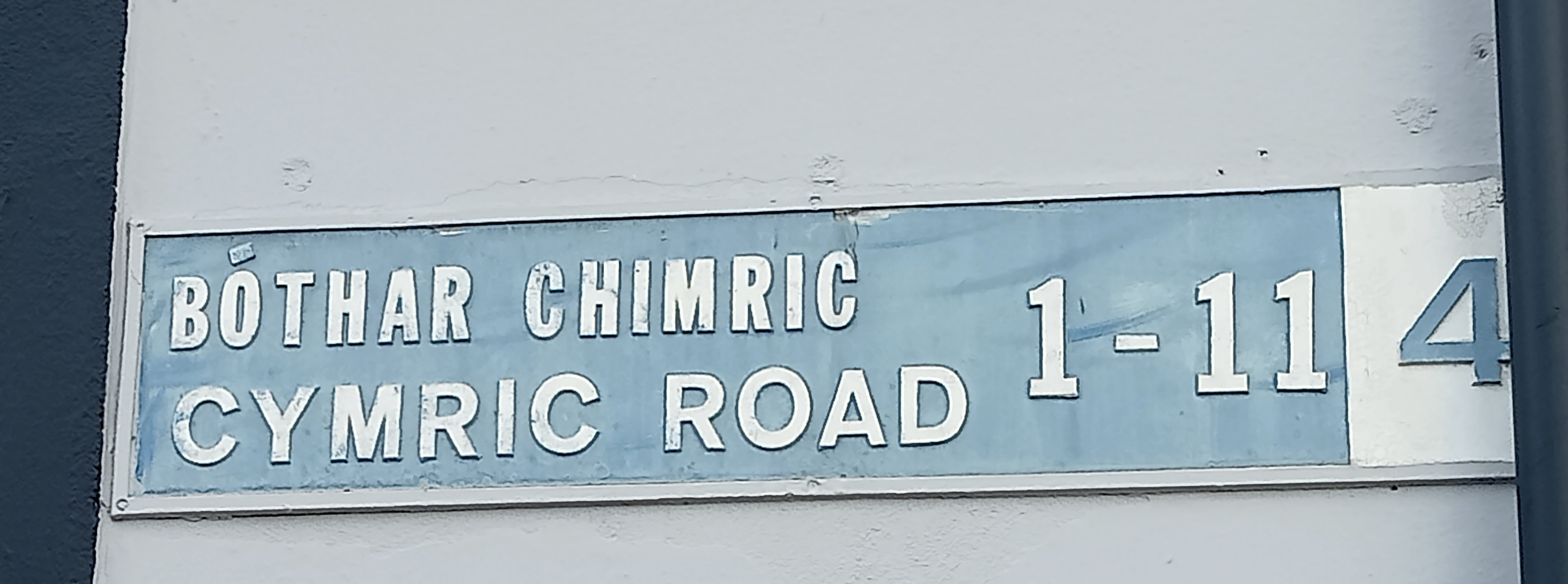
Cymric Road, Irishtown, Dublin 4- a daily reminder of the brave sailors of the Cymric. Photo: Author
In the Irish Press on February 23rd, 1967, Captain Desmond P Fortune, a famous Wexford Master Mariner during the Emergency years, wrote the following:
“It would be impossible to recall the epic of Ireland’s successful fight to maintain her vital overseas supply lines during the war years without including the story of the schooner Cymric of Dublin, on the Lisbon trade, and her subsequent loss with all hands.”
Few would disagree.
Sailing Ships of Wexford, 1840s- 1940s – A Century of Sail in Co Wexford by Brian Cleare and Jack O’Leary (Saltee C Publications 2019) was the prime source of information to complete this article.
Thanks to David Carroll (April 2026) for allowing the project to publish this article
Tides & Tales
We are a community-based initiative, created with passion, sustained by curiosity, and kept afloat by the generosity of people like you. If Tides and Tales has informed, inspired, or simply entertained you, there are several meaningful ways you can help us continue our work.
- Share this story with a friend, family member, or colleague.
- Leave a comment with feedback.
- Subscribe below to stay connected with our latest content.
- Other ways to assist financially if you can, include;
Donate—even a small contribution helps us keep the stories flowing.
Visit our shop and consider a purchase; all proceeds directly support the project.
Every positive action, big or small, helps us to keep Waterford Harbour’s rich maritime legacy alive and accessible for generations to come. Thank you for being part of the journey.
Dear Sir,
I greatly enjoyed reading your article on “CYMRIC” a brave but unlucky ship.
My grandfather was captain of the Cymric when it was declared missing in February 1944 and in the interests of clarity I would like to confirm to you that the correct spelling of his name is Christopher Francis Cassedy and not “Cassidy”as appears in the article.
Captain Cassedy was a White Star Line Officer who served during WW1 transporting Anzac Troops to the European Theatre of War.
Captain Cassedy is one of only 58 recipients of the 3 bar, Irish Merchant Marine Medal 1939-1946, in addition to the WW1 Mercantile Marine Medal and 1939-1945 War Medal.
Prior to WW2 Captain Cassedy had served as Harbourmaster to Dun Laoghaire Harbour (1933-1938) having been assistant Harbourmaster before being appointment to the substantive post (See short biography of Captain Christopher Francis Cassedy on the Dun Laoghaire Harbourmasters website).
Yours sincerely,
Paul Cassedy
Much appreciate the point of clarification Paul, corrections now made. Apologies for any upset caused. I will also seek the short biography you mentioned and add it in. Andrew