
Geoffrey Spencer was the founder of the Spencer shipping operation which burst into life with an all or nothing bet on Waterford’s quays in 1869. This story charts the family shipping enterprise that flourished for almost 50 years from the initial fateful risk on the purchase of the Newfoundland brigantine Oriental.
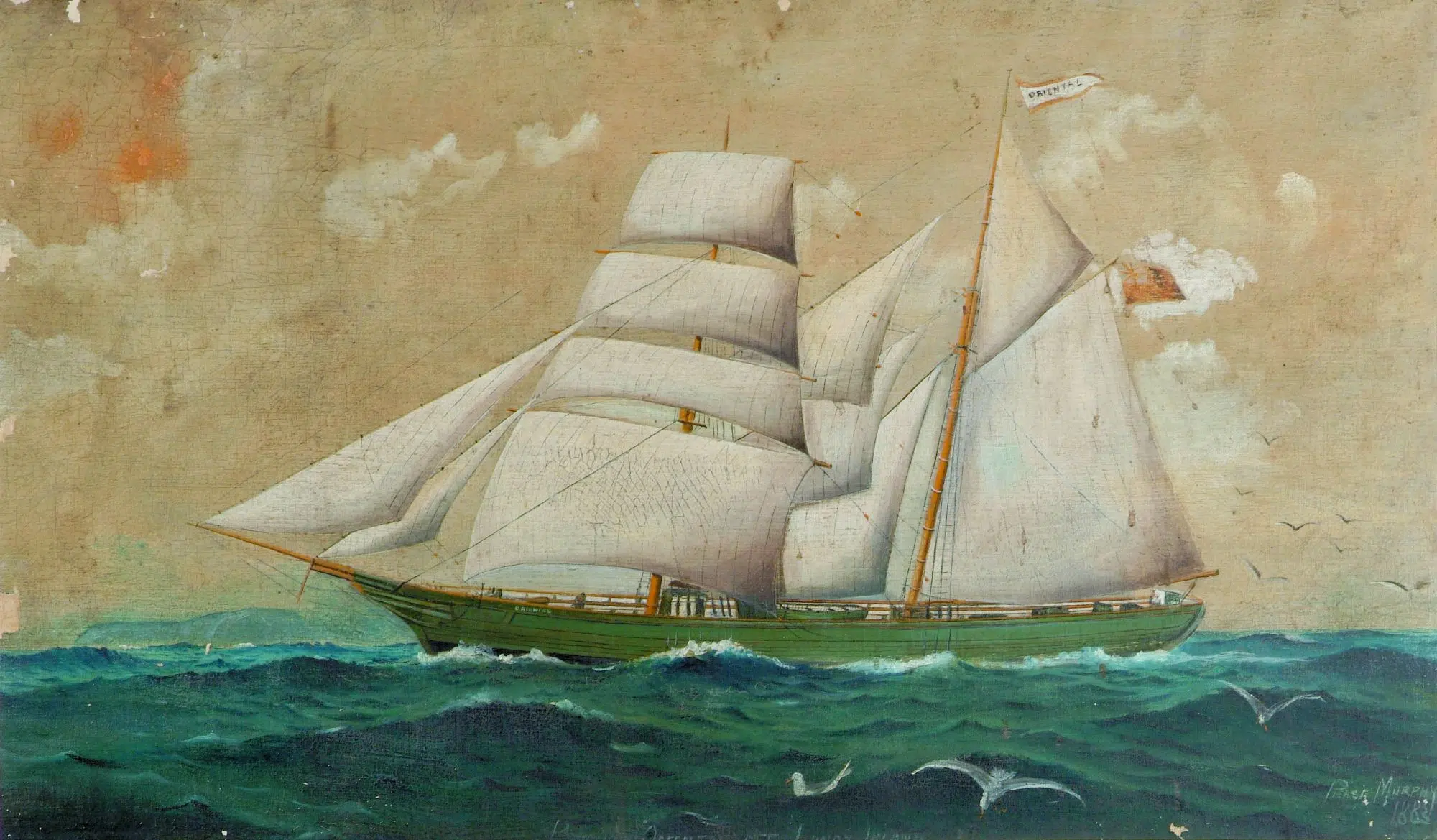
Original artwork Pierce Murphy courtesy of Waterford Art Collection/Waterford Gallery of Art. Note the green hull, a feature of all Spencer’s vessels.
Geoffrey Spencer was the son of a farmer (John Spencer of Killure), but not the eldest, and so, he could not hope to inherit. According to his late descendant, Geoff Cronin, he arrived in Waterford with £100 in his pocket and a mission to make it work for him. In Geoff’s book The Colour of Life, he describes how his ancestor found a group of Waterford merchants gathered around a vessel that was about to be auctioned. There were no bids, however…they believed the ship to have a soft hull – her planks were rotten, and bidding was slow. Sensing an opportunity, he gambled on his instincts despite it going against all these wise and careful businessmen. Spencer’s bid paid off, and the Oriental (1857) was knocked down to him and would be part of the fabric of the Port of Waterford up to 1888.
Another account stated that when he came upon the vessel, she was partially filled with coal. She was being sold as seen and having bought the vessel with very obvious hull damage, he shovelled the coal over the offending section. When the surveyor came aboard, he couldn’t be bothered to have the coal shifted. The Oriental was passed for sailing, and was shifted across to the Ferrybank side to Whites shipyard and the damaged timbers replaced. Whatever the truth, either story highlights a man who was willing to take a risk in order to get ahead. As to the exact date of any auction, the actual event in 1869 is still uncertain.
A third account was published after Geoffrey died in 1917 in the Evening News. Simply signed E.B. the writer who was familiar with the late Geoffrey, stated that the hesitancy to bid on the ship was due to a general concern about the quality of North American ships. However Geoffrey had advice from a man called Tom Dunne of Rhineshark area. So while others hesitated Geoffrey followed Tom’s judgement and he would afterwards go captain of the vessel. No alone was she structurally sound, but according to E.B. the Oriental was one of the finest and most reliable vessels to have ever sailed from Waterford.

Munster Express – Saturday 13 February 1869; page 7. Accessed via BNA Public Domain
There are two very tantalising mentions of the Oriental in the local papers of 1869 however, at least thats all I could find. In early February, the local Munster Express newspaper states that the ship is due from Newfoundland with a cargo of fish, and will be sold on arrival. For some reason, the only mention of her auction is in July. A long wait for sure. This was carried by the Waterford Standard, posted in June, but from an edition of the paper on July 28th. Again, its the detail of the vessel, going for auction on July 29th at 1 pm, the ship lying at the Market House Quay in the city. (For the Market House, then located between Hanover St and Gladstone St) Details could be had from James Kent & Son of George’s St., or from the auctioneer Thomas Walsh, The Mall.
Did she sell that day, or later? Indeed, had there been an earlier auction without bids. I can’t say.
However it happened, a farmer’s son bought a well-found ship (or managed to pass it off as one) and she became the making of his fortune. According to Geoff Cronin, his business was based on the importation of coal from Wales and the shipping of pit ponies and pit props by return. He also invested in the mines, and it seems, through marriage, centred his business on Johns St in Waterford, where his coal business flourished alongside a lime kiln and gravel yard, which was accessible via the St John’s Pill.
My understanding was that Geoffrey was already in the coal trade when he got into the shipping business. He had married Catherine Lyons; her father was in the coal business, which Geoffrey and Catherine inherited. By investing in a ship, the pair were cutting out the middleman! [My assumption was confirmed post publication by Louise Spencer Leacy who told me that the couple married in November 1864]
I have previously met John Spencer, a relative, with the one and only Brian Cleare. Despite taking notes and being loaned (and returning safely) John’s materials on the family, I cannot locate my notes and only have my memory to go on. But one thing that John had mentioned was that when the coal business was slack in summer (if you will forgive the pun), his ships would take any freight available. One included mud to Cardiff in Wales, where it was sold as filling for the expansion of the docks. I was surprised by this but when researching a recent talk on the Portlairge I found several mentions of this trade. It wasn’t the sloppy mud that is visible along the present quays, but the harder, claylike substance further down.
At the time of writing, I have not found any great drama associated with the ship ceasing on Lloyds register in 1888. Perhaps she was hulked and laid up somewhere to live out her days as a floating pontoon, I would have thought anything more dramatic would have made a headline in the papers. (Before publication, David Carroll informed me that she was hulked at New Ross.) But it was also interesting to note that other local names were associated with the vessel in later years, including Captain Nicholas Cummins, Thomas Furniss and George McDonald. I am speculating that they may have had shares in the vessel?
Over the subsequent years, the Spencer line grew. He purchased the Arrow (1857) in 1873 and she ran until 1885. Next was the Nancy (1844) bought in 1875 she was sunk on a return voyage from Wales in June 1882. The Caradoc (1873) replaced her in 1884 but had a short lifespan – to 1886. Next was the Olga (1875) a two-masted brig – she ran from Waterford from Jan 1886 until 20th April 1895 when she was lost at Booley Bay, Co Wexford. The crew survived, however, by rowing upriver to Duncannon. The wreck and cargo was later sold to Stephens of Duncannon. I hope to have more on this, thanks to Hugh Burke, in time to come.
His last two ships have featured on the blog before. The Madcap (1871) was part of the fleet from 1884, and finally, the Zayda (1888) was added to the company in 1898. Both ships were requisitioned by the navy as Q ships in WWI, and the last sailing of the Madcap I found was 1921 – a long journey. She left Cardiff in February and limped into Waterford in April. Both ships were laid up against Waterford quays in 1922. It was so much easier and faster to rely on steam at that point. Both ships were towed away from Waterford to be scrapped in 1928.
I hope to explore the details of his other ships in time, but one detail that needs further digging is the question of the steamer Silkstone. She sank following a collision with the SS Reginald in 1882 in the river just opposite the present Plaza. Owned by the Cox brothers of the Mall, it seems Geoffrey may have had shares in the vessel. The name Cox does come up in association with his business elsewhere, especially Michael Joseph.
Geoffrey Spencer died in April 1917 and is interred in Ballygunner graveyard. His first wife, Catherine who died in 1877, is interred to his left, his second wife Mary, is to his right; she died in July 1899. Many of their children are mentioned too. Geoffrey and Catherine had five or possibly six children, he and Mary had ten.
Geoffrey and his ships are now just a memory – but an important part of the maritime story of Waterford. A story of a man with a lot of drive, guts and not averse to taking a gamble.

My thanks to Louise Spencer Leacy for extra details on this post publication which have been added.
Tides & Tales
We are a community-based initiative, created with passion, sustained by curiosity, and kept afloat by the generosity of people like you. If Tides and Tales has informed, inspired, or simply entertained you, there are several meaningful ways you can help us continue our work.
- Share this story with a friend, family member, or colleague.
- Leave a comment with feedback.
- Subscribe below to stay connected with our latest content.
- Other ways to assist financially if you can, include;
Donate—even a small contribution helps us keep the stories flowing.
Visit our shop and consider a purchase; all proceeds directly support the project.
Every positive action, big or small, helps us to keep Waterford Harbour’s rich maritime legacy alive and accessible for generations to come. Thank you for being part of the journey.
Great research as always! A very interesting story!
Love the green hull. An interesting read as always.
Nice story and painting Andrew. The vessels built by Connick in Dundalk also had green hulls but of a darker hue and carried a gold band around, they were much admired.
Very interesting piece of history. Many years ago a fellow trainee nurse in London with my wife was Anne Spencer from Waterford! As for the Oriental, she was built at Tatamagouche, Nova Scotia in 1857, and owned first by Walter Grieve and then Philip Cleary in St Johns Newfoundland before transfer to Geoffrey Spencer and disappears from the Mercantile Navy List after 1888. At that time the brigantine was becoming unusual and most vessels had been re-rigged as schooners. or even as ketches.
Yet another great story of Waterford