David Carroll guest post
Malcomson legacy
Waterford’s maritime history remains intrinsically linked with the Malcomson family. Had the Malcomson conglomerate of enterprises, which included ship owning and building, continued to prosper, one can only speculate as to how different Waterford and the surrounding region would be today in terms of prosperity and national importance. Sadly, the business went into decline.
The American Civil War in 1861 cut off their vital cotton supplies. This triggered an economic slump that devastated their once-thriving Portlaw cotton mills. The situation worsened in 1866 with the collapse of Overend, Gurney & Co., a prominent London bank that owed £11 million—much of it belonging to the Malcomsons. Family squabbles and monies being withdrawn exasperated matters, culminating in Malcomson Brothers declaring themselves bankrupt in January 1877.
Most of Malcolmson Brothers’ assets and enterprises were either sold off or liquidated. The famous Neptune Ironworks passed on to the Waterford Steam Navigation Company, managed by Cornelius Morley, a son-in-law of William Malcomson, but the yard now had a diminished workforce, only completing orders for steam yachts. The remaining ships became part of the fleet of what would now be called the Waterford Steamship Company, which survived from 1877 until 1912.
Soon after 1877, the Waterford Steamship Company felt financially strong enough to order new tonnage and we begin to see ship names with strong local connections: Reginald (1878), Comeragh (1879), Creaden (1883), Ardnamult (1883), and Dunbrody (1886). These ships were all built on the Clyde and the Tyne. The days of large ships being built in Waterford had passed.
The last large ship built at the Neptune Iron Works for the Waterford Steamship Company was the SS Lara in 1868. She was 471 tons registered and 240 ft in length. With her sleek lines and powerful engines, she reduced the passage time on the Liverpool to Waterford route from 30 hours to just over 18 hours.
The Dunmore East Connection
The names Creaden and Ardnamult will resonate with the Dunmore East community, as these vessels were called after the two headlands that are prominent when looking towards the north-east from the harbour.

Waterford Harbour: Chart showing Creaden and Ardnamult Heads, NE of Dunmore East.
Creaden Head, located about 2.5 miles from Dunmore East, is a strategic point in the Waterford Estuary, and is the most easterly point in County Waterford, and in the Province of Munster. Creaden Head is derived from the Irish, Ard Chríodáin. Chríodáin probably refers to a Celtic deity or chieftain. It is an area of significant archaeological and historical interest.
Prehistoric artefacts, collected over a forty-year period by the late Noel McDonagh, of Dunmore East, in the Creaden Head area, have been examined by eminent archaeologists, who have concluded that some of these finds were over 10,000 years old. This indicates that the area would have been one of the oldest settlements in Ireland.
A prominent, mysterious set of steps, hewn into the cliff, known as the “Forty Steps” can be seen at Creaden. Various theories exist on their origin, including use by the Knights Templar for a ferry to Templetown, across the estuary on the County Wexford side. Other theories suggest that it might have been a landing spot for slaves or more likely smugglers. The area was also a key site for quarrying millstones used in local milling, which were transported to other areas, even as far as Dublin, as evidenced by the recent discovery of a shipwreck with millstones at the entrance to Dublin Port.

Forty Steps at Creaden Head
Ardnamult Head is not a large promontory like Creaden Head, situated about a mile closer to Dunmore East. It derives its name from the Irish meaning the height of the wethers. A wether is a castrated male sheep. Locally, the headland is often referred to as Middle Head. Just like Creaden Head, this part of the coastline has seen many dramatic shipwrecks and rescues over the years.
The most famous rescue at Ardnmult Head took place in 1964. The Dutch coaster, Jan Brons, went aground on the rocks in a south-westerly gale with a rough sea running on Match 11th of that year and the crew of six were rescued by the Dunmore East lifeboat, RNLB Annie Blanch Smith. Coxswain Paddy Billy Power was awarded a third bar to his Bronze Medal. Bronze Medals were also awarded to Second Coxswain Stephen Whittle and Assistant mechanic John Rocky Power.

L-R: Stephen Whittle, Paddy Billy Power, and John Rocky Power, all awarded RNLI Bronze Medals for rescue of six crewmembers of MV Jan Brons at Ardnamult Head, March 11th, 1964. Photo: John Aylward.
SS Creaden
The SS Creaden was launched on March 28th, 1883, at the yard of J.T.Eltringham at South Shields, a coastal port town on the south bank of the mouth of the River Tyne. The vessel was registered in Waterford.

SS Creaden. Image: From a Private Collection. Paintings of the SS Creaden and her sister-ship, SS Galtee are displayed in the Granville Hotel, Waterford.
The Waterford News of March 30th, 1883, contained the following news item:
A new steamship named the “Creaden,” a sister ship of the “Galtee,” has been launched at South Sheilds this week for the Waterford Steamship Company. This is an excellent acquisition to a fine fleet of vessels. The Waterford Steamship Co. Is purely Irish, and has peculiar claims on the trading public.
The SS Galtee had also been built at the same yard in South Shields in 1881. One wonders if the directors of the Waterford Steamship Company found satisfaction with the Galtee that prompted them to place an order for a similar vessel? The tonnage and dimensions of the two vessels were very similar. Waterford Steamship Company sold the SS Galtee to Goole in 1890, and after passing through many owners and name changes, it was 1931, before she was scrapped.
On Christmas Eve, December 24th, 1884, the SS Creaden collided with the steel full-rigged Garston of Liverpool at Cardiff. SS Creadan returned to Cardiff for inspection, as did the Garston, a 267ft vessel, only built in 1883, which was on a voyage with coal to Bombay. She had several plates damaged. Before she was refloated, she was run into by an Italian barque, Christopher Columbus. It was June 1885, before the Garston was in a position to eventually set sail for Bombay. The Garston was wrecked in 1889 on a voyage from New South Wales to San Francisco, with some of her crew being adrift in a boat for two thousand miles, over twenty-three days, before being saved.
In 1900, according to ‘Tyne Built Ships’,SS Creaden was sold to Alfred H Read, Liverpool and to FH Powell & Co, Liverpool in 1905, who renamed her as North Coast. The Powell company was later to become the famous Coast Lines Limited. In 1906, she was sold to Montevideo, Uruguay, and became General Pueyrredon. In 1919, it was renamed Peronne by a company in Argentina.
Terry Conlan’s Irish Merchant Ships and Shipowners, account of the SS Creaden, after it left Waterford ownership, varies slightly. Terry Conlan states that, as Peronne, the vessel was under the French flag and was stranded near St Valéry sur Somme, after which she was refloated and scrapped in 1924.
SS Ardnamult
The SS Ardnamult was also built on the Tyne at the yard of T &W Smith, North Shields, and launched on March 10th, 1883, just eighteen days before the SS Creaden. North Shields is situated on the north side of the River Tyne, close to the mouth of the river.
The ship was built to the order of the Waterford Steamship Company, whose owners were listed as: Abraham Denny, John N White, William D Goff and Cornelius Morley. Strangely, the SS Ardnamult was registered in London. Also, the ship operated in Limerick Steamship Company colours. The two companies were closely interlinked as regards ownership. Limerick ships adopted the Waterford colours. The black funnel, with a broad red band, was altered slightly by adding a thin white band beneath the red band.
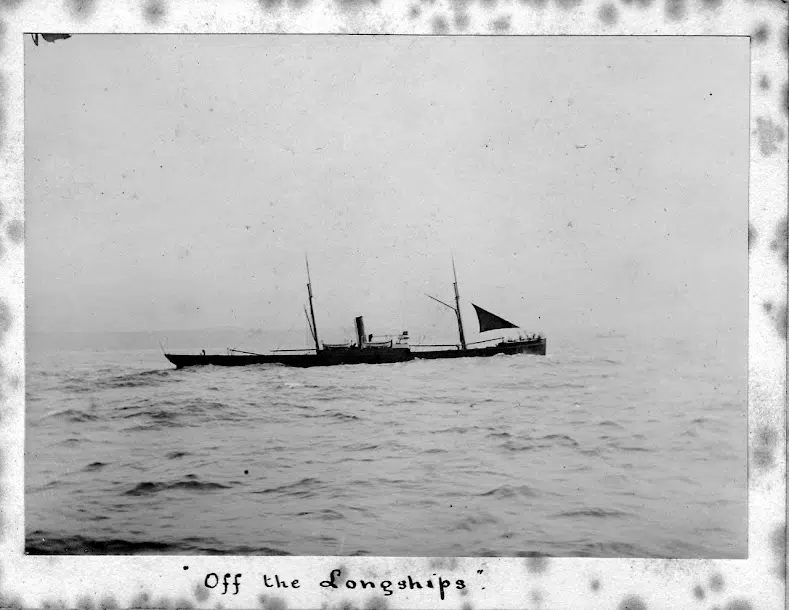
SS Ardnamult, off the Longships, Lands End, Cornwall, courtesy of Brendan Grogan.
The seafaring career of Captain Walter Farrell, Harbour Master at Waterford from 1904 until 1941, forms a strong link to both of the ‘Dunmore’ steamers. In 1892, after eleven voyages, some lasting as long as nineteen months, over a period of fourteen years, to all corners of the globe, Walter Farrell gained his Master’s Ticket for steam ships and joined Waterford Steamship Company as Second Officer on the SS Comeragh, which ran between Tenby, Bristol and Wexford. He was subsequently, in 1895, placed in charge of the SS Creaden, which had the honour of bringing the first cargo of continental sugar to Fenit and Limerick. He was appointed Master of the SS Ardnamult, owned by Limerick Steamship Company in 1896 and plied this and other steamships between Hamburg and Ireland for nine years.
The Irish Times of March 21st, 1896, carried the following news item:
COLLISION IN QUEENSTOWN HARBOUR
A collision occurred at the mouth of Queenstown Harbour yesterday morning, between the Waterford steamer Ardnamult, from Galway to Cardiff, and City of Cork Steampacket Company’s steamer Xema from Bristol to Cork, with passengers. The Xema was holed below the water-line, and had to be run on Courland Bank to prevent her foundering. It is stated that both vessels had their lights burning at the time. The passengers were landed in Xema’s boats. The Ardnamult is also extensively damaged.
The SS Ardnamult was lost in 1904. The Munster Express of June 26th, of that year, carried the following news item:
LIMERICK STEAMER SUNK
THE CREW RESCUED
A Lloyd’s Amsterdam message states that the British steamer Ardnamult, Hamburg for Limerick, with a general cargo, has been in collision with a Dutch torpedo boat. The steamer foundered ten miles north-east of the Hanks lightship, but the crew were saved and landed at Nieuwe Diep. The Ardnamult is well known in Waterford, where she discharged many cargoes of sugar for local merchants. She was for several years commanded by the Harbour Master, Captain Walter Farrell.
The name of the torpedo boat was Pangrango. The sinking took place on June 22nd.
The end of the Waterford Steamship Company
In 1912, the Clyde Steamship Company, which had regular sailings from Waterford dating back to 1856, wishing to extend its cross-channel interests, agreed to buy out their main rival, the Waterford Steamship Company. Negotiations resulted in the purchase of Waterford Steamship Company’s Liverpool and Bristol trades and their three steamers, SS Clodagh, SS Dunbrody and SS Reginald, for a total figure of £54,000.
The SS Clodagh was renamed SS Coningbeg by its new owners, and along with the SS Formby, built in 1914, were the two ill-fated Waterford steamers torpedoed and sunk by the German submarine U-62 off the east coast of Ireland at Christmas 1917 with the loss of eighty-three persons, sixty-seven of them from the city of Waterford and surrounding areas. Throughout the First World War, from its outbreak in August 1914, these two ships had bravely continued to sail the Waterford / Liverpool run, transporting desperately needed food and supplies to Britain.
The SS Dunbrody became SS Arklow under the new ownership and continued to give impressive service up to 1931.
The SS Reginald made her final sailing to Liverpool in early July 1914. She was withdrawn from service shortly afterwards and was replaced by the Clyde Shipping Company’s new ship, SS Formby. In September 1914, SS Reginald was sold to the Admiralty and was later sunk as a blockship at Scapa Flow in the Orkney Islands.
Notes
The listing of SS Creaden and SS Ardnamult in Terry Conlan’s excellent ‘Irish Merchant Ships and Shipowners’ ( Tuskar Rockabill Publishing, Catalpa na Mara Imprint, 2025) inspired the search for further information on these two vessels. The book proved to be a valuable source.
The headland, 2.5 miles NE of Dunmore East, is often spelt as CREADAN, but as the ship was registered as CREADEN, I have continued to use this spelling to be consistent.
Many thanks to Brendan Grogan, grandson of Captain Walter Farrell, for kindly sharing his images of SS Ardnamult. Thanks also to Brian Cleare for his kind assistance.
SS Mary Monica, a steam collier, belonging to my great-grandfather, James J Carroll, was sold to FH Powell & Co., Liverpool, in 1897, the same firm that had named SS Creaden as North Coast. Powell’s renamed Mary Monica as South Coast.
David Carroll April 2026.
0 Comments