
On Saturday, April 4 2026, something very special happened at Cheekpoint Quay. After many years, the fishing vessel Reaper returned to the village. It was an emotional event for many of us on the Quay that day. One of our own had put his money where his mouth was and, against all odds, managed to restore his grandfather’s old fishing boat. Jim Doherty was the original owner of the Reaper in the village, but the vessel had a rich history before that. Having been sold in the 1990s, he tracked her down as a rotting hulk in a garden in Kilkenny, and now the vessel is restored and Jack and his family plan fishing heritage trips from Cheekpoint, kicking off in May. A new website for the venture is being worked on and will soon be fully operational at Dipp’s Trips.
For me, though, this moment carried an even deeper significance. For it was in the autumn of 1983 that I first went fishing as an eighteen-year-old in Waterford Harbour, and the Reaper was the boat that was my introduction to this different world. In the piece that follows, I’ll look back on that first herring season in the harbour, the people I worked alongside, the fishing practices that were so new and the fondness for a vessel that has stayed with me ever since.

Fishing off Dunmore East and the Hook was an unfamiliar place for me, having been reared on the rivers around Cheekpoint. I was familiar with driftnetting the salmon as far as Passage East, or potting for Eel to Waterford City or New Ross and all points between, but the lower harbour was more dangerous and unpredictable than the fishing I had known heretofore. Some nights were threatening, indeed terrifying, with dangerous seas and unpredictable conditions. At the same time, others were magical, still and calm, with star-reflected oil-like seas and a gentle breeze. Deep water also meant the dreaded seasickness, something I’d never known up to that point, and something I would never want to experience again. But it was the fishing itself that was so different, boats, nets, fish, conditions and practices.

The remains of the Reaper in Kilkenny, photo courtesy of William Doherty
In the autumn of 1983, my first autumn as a free man, having left secondary school that June, Jim (Dipps) Doherty approached me on Cheekpoint quay and asked whether I would like to come with him and Denis (Harvey) Doherty to drift for herring. I jumped at the chance.
That afternoon, I was aboard the Reaper, a fully decked motor boat with an enclosed cabin forward. She was the only one of her type in Cheekpoint at the time. (Most of the boats were half deckers, with open decks and, if you were lucky, a small weather deck and cuddy) When waves broke across the Reaper, they swished around the deck before escaping via the scuppers. She still required bailing, but not as regularly.
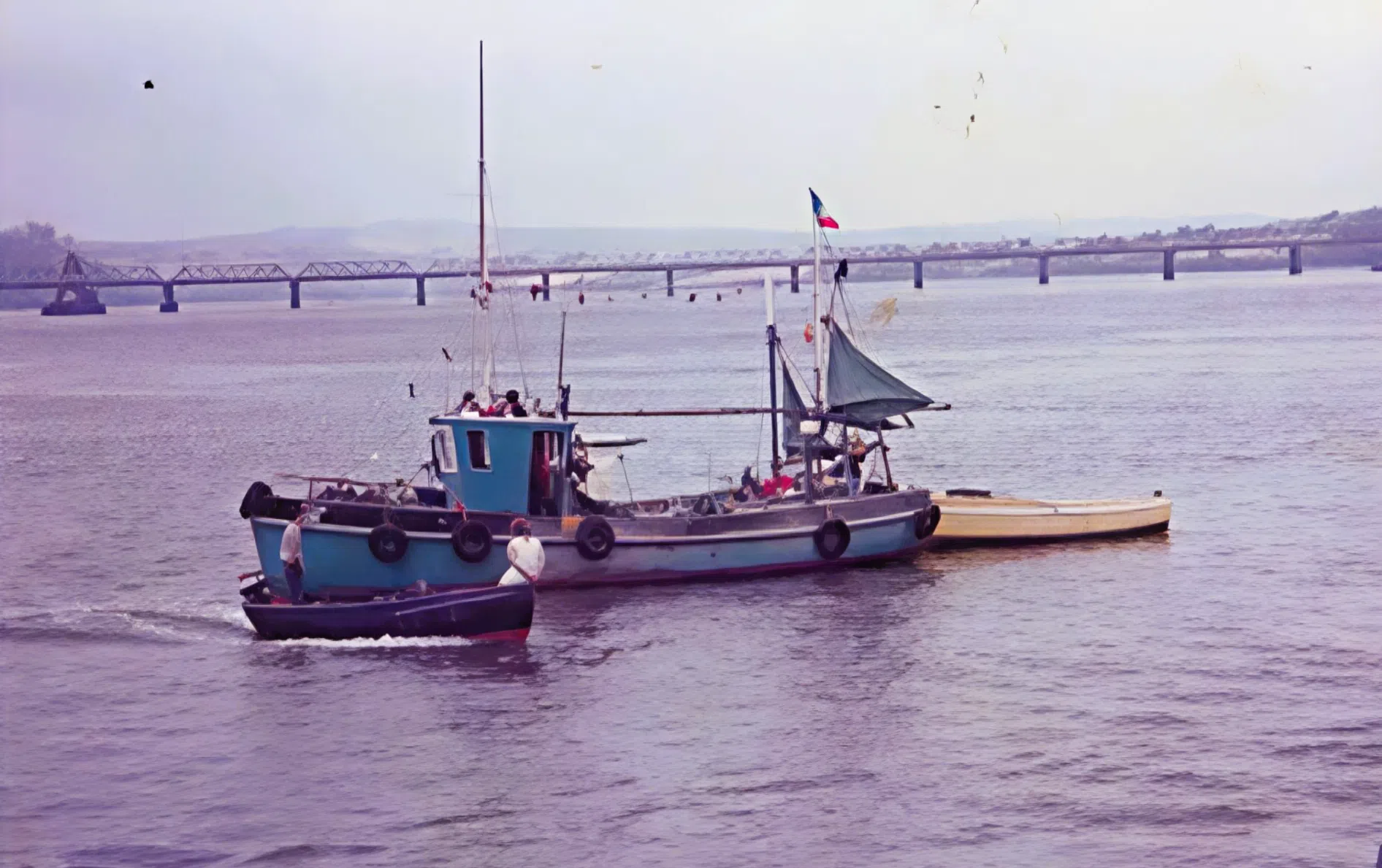
The Reaper as flag boat at a Cheekpoint regatta in the 1970s. Photo courtesy of Anthony Rogers.
Jim and Denis were as different as chalk and cheese, but the one thing they shared was that you would never see either of them without a fag in their mouths. Jim smoked constantly, lighting one after the other. But occasionally he would remove the fag as he paused to consider a response to a question. Denis, on the other hand, never seemed to be without the fag in his mouth. It hung from his lip, whatever the job, and I often marvelled at his ability to chat away, with the fag hanging off his bottom lip, until it burned right down till there was almost nothing left, and yet he never seemed to notice.
All was different on the herring boats. Growing up with salmon, I knew my way around nets and the boats. But the herring nets were deeper and the meshes smaller. They still had a lead rope to sink them and a head rope to help the upper end float, but the head rope had much smaller corks. This was to allow the nets to sink down to the level the herring were swimming at, and this depth could be moderated via gallon cans on a few fathoms of rope, which could be lengthened or shortened as required, stationed at regular intervals along the head rope.
Instead of a buoy, a dan was used on either end of the nets. A dan was a homemade marker. It was usually a straight stick of hazel (although broom handles were coming into fashion then). In the middle of the stick was either a buoy or a slab of builders aero board for flotation. The dan was weighed down with bricks or lead. At the other end, each boat had a set of colour flags atop made out of fertiliser bags or fabric; each boat had its own colour to distinguish each other. At the top was a flashing winkie (light), so that you could see your nets in the dark.

An example of how the herring driftnet fished in the harbour. Courtesy of F&AO UN 1975. Note no dan present
The nets were ranged over, and another difference was that each net was tied at the head and the lead rope, but the actual net meshes were not joined. The herring drifted in vast shoals you see, and nets might need to be separated and left to other boats to haul if the catch was too big.
When a mark of herring was made, the nets were set, in much the same way that I knew from the salmon boats. But it commenced with screwing tight the winkie and that was tossed well clear of the boat as the cork rope followed it over. Once set, the end was marked by another dan and we stood by. Jim would get the kettle on and the sandwiches would be taken out. Another difference for me – we never had grub driftnetting salmon, always came home for grub, although many was the time after several hours fishing, I wished we had.
Once the tea was had, and the tea was something Jim was particular about, we would check the nets. Denis and Jim would consult and decisions were made whether to haul away or let them be. A difficult choice as if left too long they could fill the nets and be under severe pressure.

Hauling the herring nets. Photo courtesy of William Doherty
Instead of hauling the nets by hand, the Spenser Carter net and rope hauler was operated via hydraulic pipes, and once the net was heaved over it and the motor engaged, you put your energy into hauling the ropes and dragging the catch to the deck to be stowed. Another difference was that as you hauled, the boat was kept on the nets via the engine and the mizen mast astern. At the salmon nets, we rarely used an outboard, and usually only in an urgent situation, preferring to haul sternwards and using the oars for direction.

The Reaper returns to the village in less-than-ideal condition. Photo courtesy of William Doherty.
Another significant difference was that you used a fish finder to identify the swimming shoals. Of all the equipment aboard the Reaper, this was the one I found the most amazing. I guess that up to then, all the knowledge I had acquired about salmon was handed down and learned the hard way. It was about the natural elements and a sense of how the salmon thought and swam. It had been thus with herring before, watching the surface for oil, looking at the actions of the diving birds, spotting foraging seals and what they emerged with on the surface.
A large haul of herring meant a long night of shaking. The herring were caught by the gills in the meshes, and the nets had to be stretched and shaken to release them onto the deck. If only salmon were as plentiful or as easy to catch.
Perhaps the most significant difference was that the herring were fished at a particular time of day. We left before sunset, the intention being to locate the fish and set the nets before darkness, when the herring would start to rise from the seabed. Heretofore, at salmon or eel, I had worked with the tides, day or night, hauling and setting to the rhythm of the gravitational pull of the moon and sun on the earth.
I felt like a real man, that first evening going down onto the quay with my grub bag, and stowing it on the Reaper. Jim started the engine and I let go the ropes forward and aft, and Denis took them aboard. Jim took her away from the quay as I leapt aboard and then we bustled around with the last-minute jobs, stowing fenders, ropes etc, checking the nets and that all was in order before we got down the harbour. It was 3 pm in the afternoon and we needed to be on the herring grounds to set as dusk fell.
All around us the other Cheekpoint boats were leaving too. My father was in the Boy Alan with Robert Ferguson (skipper) and Eamon Power. The St Agnes was skippered by Dick Mason and had Edward Ferguson aboard and a school mate of mine, Brendan Foley. The Colleen II was also there, Ned Power, John Joe and Matt (Spoogey) Doherty and the Maid of the West was also there, a much older and smaller boat, with the brothers; Mickey, Paddy and Jack Duffin. I think it was the next year that Sean (Hops) Doherty joined with a new boat with his father John, and Jimmy O’Dea. John Ferguson would join later, I remember Tom Sullivan and Seamus Barry also crewing, when on their month off on the Bell boats. At some point Michael Elliott joined in with a fine new boat, the Glendine.
I was following in the footsteps of generations of Cheekpoint fishermen, who had departed to fish in the lower harbour. I’d heard many stories, and knew that boats like the Maid of the West, which was originally owned by Michael Heffernan (High St) many years before, had been rowed down, nets set by oar, hauled by sheer strength and then rowed home again. I knew that men had lost their lives at it, and that even with the modern conveniences, it was no cake walk.
I would know the fear of watching seas breaking over the stern and washing over the decks, be totally lost in a clinging fog, only to narrowly avoid the cliffs at Dunmore, and know how humbling and humiliating seasickness could be. All that was to come, but that evening, standing on the forward deck of the Reaper, I only knew excitement, and that I was starting a new journey on my relentless road towards adulthood.
I related many of the Reaper experiences on the blog before and they featured in my first book, Before the Tide Went Out.
However, this is a story not so much about the past as the future. I was aboard the Reaper again recently, standing on the deck and enjoying a very different experience. A beautiful, comfortable and safe boat, she is the ideal way of seeing the rivers and learning about the rich maritime and fishing heritage of the area. I can only imagine the fun times Jack and his family will have with their boat, and I certainly wish them every success with the venture. Who knows, maybe we might go herring fishing yet!
If you want to see more of the journey to the restoration, Jack’s dad, William, chronicled much of the journey on Facebook on a page called The Reaper Revival. An excellent photo journey with terrific history too. Hopefully, much of this can be recorded on their new website too – an absolute goldmine of detail.

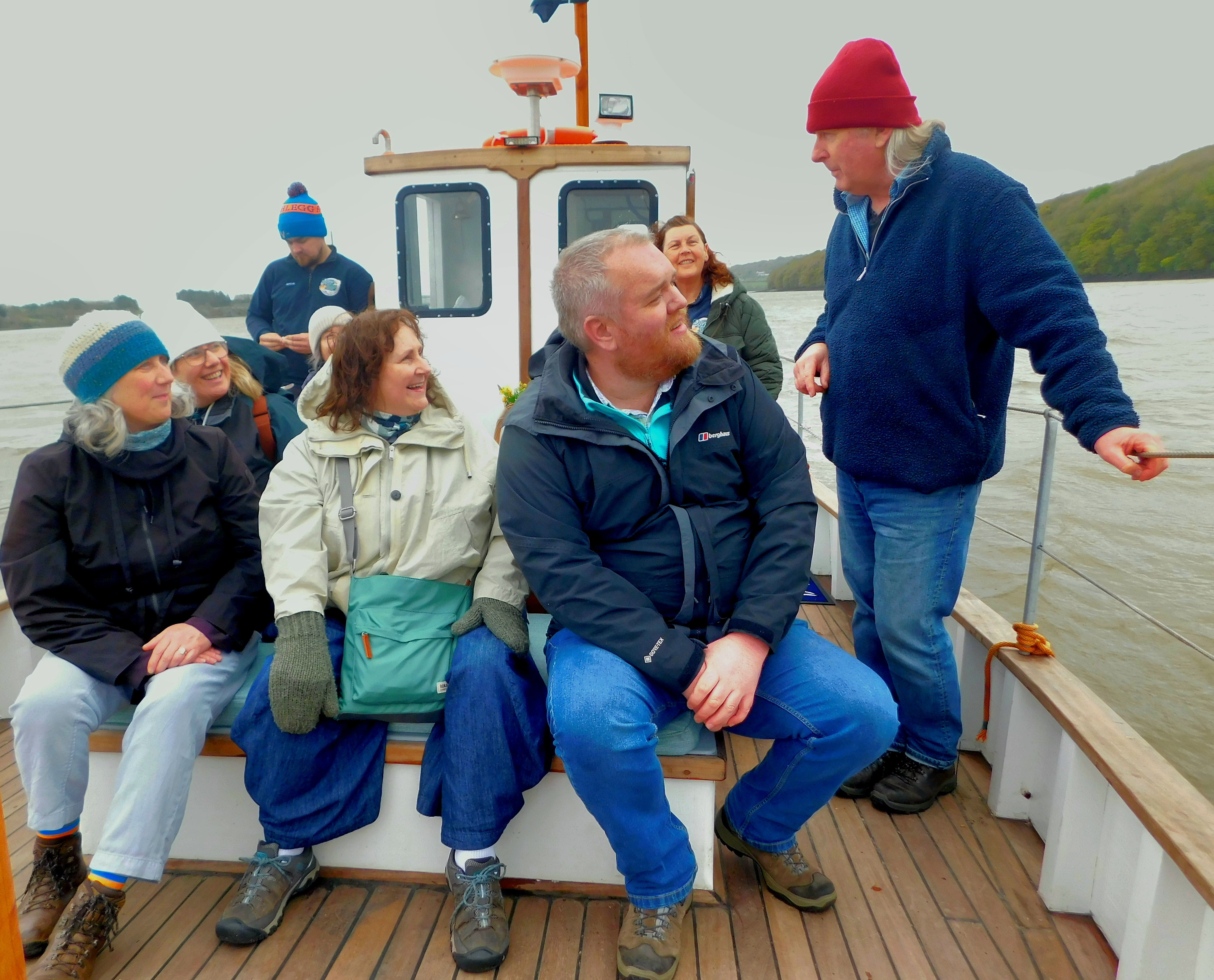
Jack and his brother James very kindly brought out our Maritime History class recently for a trip to Ballinlaw on the Ross River. The Reaper is an ideal outdoor classroom. The forward access gives you great views and the seating is so comfortable. Photo credit – Mary Bradley aka Mollies Captures

Following publication, Tom MacSweeny reached out and asked if I would be willing to share the blog story with the Marine Times. The reprised piece featured in the June 2026 edition
Tides & Tales
We are a community-based initiative, created with passion, sustained by curiosity, and kept afloat by the generosity of people like you. If Tides and Tales has informed, inspired, or simply entertained you, there are several meaningful ways you can help us continue our work.
- Share this story with a friend, family member, or colleague.
- Leave a comment with feedback.
- Subscribe below to stay connected with our latest content.
- Other ways to assist financially if you can, include;
Donate—even a small contribution helps us keep the stories flowing.
Visit our shop and consider a purchase; all proceeds directly support the project.
Every positive action, big or small, helps us to keep Waterford Harbour’s rich maritime legacy alive and accessible for generations to come. Thank you for being part of the journey.
Great tale again Andrew, the Harbour is a wonderful and deadly place.
Keep ’em coming
Wonderful article Andrew. I know very little regarding fishing, but appreciate the story of a man finding, salvaging and restoring a treasure.